
Dragon Link Online Pokies Australia: What Is Verified?
 Available in AU
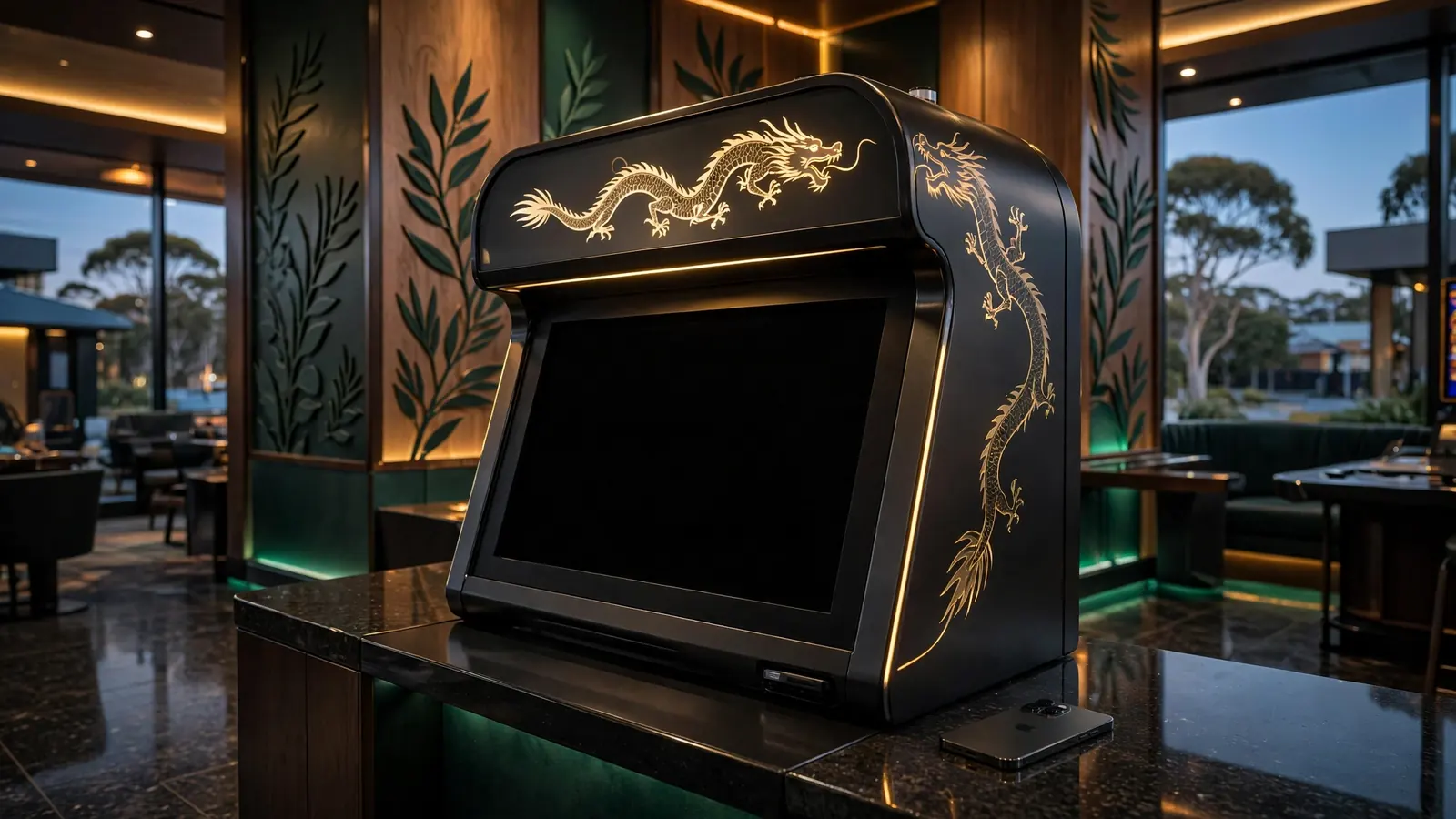
Table of content
A closer look at the Dragon Link search, Bitcoin pokie terminology and the difference between a familiar name and confirmed game details.
The Machine Behind the Search
A machine name can sound more definite than the information attached to it. “Dragon Link” suggests a particular piece of casino equipment: something with a recognisable identity, perhaps a screen, a cabinet or a digital counterpart. But the phrase itself establishes none of those details. It does not show whether a particular machine exists online, what it looks like, or how it behaves.
That distinction matters because “pokie machine” can describe a physical device or serve as shorthand for a digital game. In the Bitcoin context, the broad category is straightforward: a Bitcoin pokie is a digital slot game that takes Bitcoin as payment. That definition describes a type of game and payment arrangement. It does not identify a particular title or make every machine-related claim about one trustworthy.
The difference is easy to lose in search results, where a familiar name may sit beside polished images and confident descriptions. Presentation can make an unverified detail feel settled. A picture may depict a physical machine, a generic illustration or a design created for a webpage. A label may be copied from another listing. Neither, by itself, establishes what a digital version contains.
When looking for Dragon Link online pokies in Australia in 2026, it helps to check the limited operator details available before deciding where to play. The entries below are a concise reference, not confirmation that Dragon Link is available at any particular operator.
1. SpinsUp
License: Curacao Gaming Control Board OGL/2023/174/0082 (Dama N.V.) SpinsUp is listed with a Curacao Gaming Control Board licence, OGL/2023/174/0082, held by Dama N.V. No other operator details are provided here.
2. LevelUp Casino
License: Curacao eGaming OGL/2023/174/0082 (Dama N.V.) · Min. deposit: A$15 LevelUp Casino is listed with a Curacao eGaming licence, OGL/2023/174/0082, held by Dama N.V., and a minimum deposit of A$15.
3. MrPacho
Payout speed: crypto 30-120 minutes, fiat 24-72 hours · Min. deposit: A$30 MrPacho lists crypto payouts at 30–120 minutes and fiat payouts at 24–72 hours. Its minimum deposit is A$30.
4. Ricky Casino
Payout speed: crypto under 1 hour, PayID 1-3 business days · Min. deposit: A$20 (A$30 to qualify for the bonus) Ricky Casino lists crypto payouts in under an hour and PayID payouts in 1–3 business days. The minimum deposit is A$20, or A$30 to qualify for the bonus.
5. SkyCrown
License: Tobique Gaming Commission · Payout speed: crypto ~10-15 minutes, fiat 1-5 days · Min. deposit: A$30 SkyCrown is listed with a Tobique Gaming Commission licence. Its stated payout times are around 10–15 minutes for crypto and 1–5 days for fiat, with a minimum deposit of A$30.
6. Kingmaker
Payout speed: crypto ~90 minutes, fiat 1-5 days · Min. deposit: A$30 Kingmaker lists crypto payouts at around 90 minutes and fiat payouts at 1–5 days. Its minimum deposit is A$30.
7. Neospin
License: Curacao Gaming Control Board OGL/2023/176/0095 (Hollycorn N.V.) Neospin is listed with a Curacao Gaming Control Board licence, OGL/2023/176/0095, held by Hollycorn N.V. No other operator details are provided here.
8. GoldenCrown
License: Curacao Gaming Control Board OGL/2023/176/0095 (Hollycorn N.V.) GoldenCrown is listed with a Curacao Gaming Control Board licence, OGL/2023/176/0095, held by Hollycorn N.V. No other operator details are provided here.
9. Thor Casino
License: Curacao – Antillephone N.V. (Versus Odds B.V.) · Min. deposit: EUR 20 Thor Casino is listed with a Curacao licence from Antillephone N.V. (Versus Odds B.V.). Its stated minimum deposit is EUR 20.
10. Wild Tokyo
License: Curacao · Payout speed: crypto 30-60 minutes, fiat 1-5 days · Min. deposit: A$10 Wild Tokyo is listed with a Curacao licence. Its stated payout times are 30–60 minutes for crypto and 1–5 days for fiat, and its minimum deposit is A$10.
The same caution applies to the word “online”. It indicates a digital setting in ordinary usage, but it does not prove that a specific machine has been made available in that form. Nor does it establish that a version bearing the same name has the same presentation as any physical machine associated with it. Similar wording is not evidence of identical products.
There is a small history in this vocabulary. The machine remains the mental centre of casino play even when the cabinet has disappeared and the game is presented on a screen. “Machine” carries the older image forward: a self-contained object, designed for repeated play, with a name fixed above its workings. Online, the word can persist after the object has become a page or an interface. The language is stable; the thing it points to may not be.
That old image can encourage assumptions about what lies behind a name. A reader may expect a particular arrangement, visual theme or set of functions. Yet none follows automatically from the label “Dragon Link”. A machine-focused description would need reliable product information before it could say what the machine includes. Without that, claims about its controls, symbols, bonus rounds, sound, payout behaviour or other mechanics would be guesswork. Familiarity with casino games in general cannot fill the gap.
A further distinction sits between a category and an individual product. Calling something a digital pokie says what broad kind of entertainment it is. Saying that it is a particular machine makes a more specific claim, one that calls for identification. And describing how that machine works makes a still narrower claim, requiring details tied to that version. These are separate steps, not interchangeable ways of saying the same thing.
The phrase “Dragon Link pokie machine” may therefore sound like a complete description while leaving the central question open: which machine, precisely? A physical cabinet and a digital game are not made identical by sharing a name. Nor does a page become evidence of a game’s mechanics simply because it presents a name as a heading. The object being described needs to be clear before its features can be discussed.
Aristocrat Online Pokies in Australia: What’s Known
For Australian readers, “pokie” is familiar language, but familiarity is not confirmation. A phrase that sounds local does not establish where a service operates, what it offers, or whether a named machine is present. Those are different matters from the meaning of the word itself. Here the useful boundary is a modest one: the general category can be described, while details about a particular machine require evidence specific to that machine.
That restraint may feel unsatisfying beside descriptions that promise a complete picture. But a confident account built from assumptions is not a clearer account; it is merely more decorated. The machine-shaped idea is easy to recognise. Its workings are another matter.
Free Play, Without the Money Question
Free play and real-money play are two ways of approaching online pokies, but the distinction is about the terms of participation, not proof that a particular game or service provides both. The phrase “free play” describes play without staking real money. Real-money play, by contrast, places money at stake. That difference is simple; what it says about any named machine or website is not.
A title associated with Dragon Link may appear beside language about playing for free, yet the wording alone cannot establish that a particular version exists in a free mode, or that an Australian service makes one available. Nor does a familiar name settle what a session would involve. The play mode and the identity of the game are separate questions. Keeping them separate avoids turning a general distinction into a claim about a specific product.
Free play can sound like a miniature version of gambling, with the money removed and everything else presumed to remain. That presumption goes further than the basic distinction supports. The label indicates that real money is not being wagered; it does not, by itself, describe how a particular game behaves, what controls it offers, or whether its presentation matches a real-money version. Those details belong to the individual offering, not to the phrase “free play” in isolation.
The difference matters because money changes the character of an activity. Without a stake, a person may be engaging with a game as entertainment or simply exploring its format. Once money is involved, decisions carry financial consequences. The screen may look similar in either mode, but visual similarity would not make the experience equivalent. A free mode cannot establish what real-money play would feel like, and a real-money version cannot be inferred from a free-play label.
Online pokies with PayID in Australia: how it works
That is one reason a free-play claim should be read narrowly. It is not evidence of a real-money option, a route to one, or a guarantee that a named game is available. It is also not a reliable basis for judging how a game performs under different conditions. The word “free” answers only the question of whether money is being staked in that mode. It does not answer every question that may gather around a game’s name.
The reverse is just as important. The possibility of real-money play for online pokies in general does not establish that every title or platform offers it. A broad category can contain different arrangements, and a name repeated across pages can conceal uncertainty rather than resolve it. The temptation to treat a phrase as a complete description is understandable: online listings compress a complicated set of choices into a few words. Compression is not confirmation.
In Australia, the wording can also blur a further distinction: a general description of play modes is not a statement that a particular service is available locally. Free play and real-money play describe different modes, but they do not certify where either may be offered or under what conditions. A reader looking at a reference to free Dragon Link play should therefore understand it as a claim about a mode only if the offering itself makes that clear—not as proof of a specific Australian product.
There is a cultural reason the free version can seem reassuring. Removing the stake makes an activity appear to sit outside the older moral and political arguments about gambling: no money lost, no immediate financial risk. Yet the language still borrows the shape of gambling, and the boundary between demonstration, entertainment and wagering can be described carelessly. Precision matters. “Free” should not be made to carry promises about access, similarity, or future play that the word does not contain.
For anyone comparing modes, the useful distinction is modest. Free play means no real-money stake in that mode; real-money play means money is involved. Beyond that, the details depend on the actual game and service. A search phrase cannot fill in those details, and a familiar title cannot do so on its own. The distinction is clear. Availability is another matter.
PayID Pokies in Australia: Payments and Legal Limits
Real-Money Play and the Australian Boundary
The phrase “real-money play” sounds like a choice made at the game screen: credits on one side, cash on the other. In Australia, the more important distinction comes before that choice. The law draws a boundary around what operators may provide to people located in the country. A locally licensed online casino cannot offer residents real-money pokies. The restriction applies to online casino-style gambling, not merely to one named machine or one particular title.
The Interactive Gambling Act 2001 places the obligation on the provider. It makes supplying prohibited interactive gambling services to people in Australia unlawful for operators. Casino-style games such as pokies, poker, blackjack and roulette fall within that territory when offered for real money. The legal question is therefore not whether a game is familiar, popular or presented under a different label. It is whether an operator is supplying a prohibited service to someone in Australia.
That distinction can be obscured by the ordinary language of gaming. A digital screen may resemble a machine in a club; a balance may be displayed as credits; a payment method may be described as cryptocurrency. None of those details changes the location of the player or the legal character of the service. The online setting does not turn a prohibited offering into a locally authorised one.
There is also a difference between the operator’s conduct and the player’s position. The law’s prohibition is directed at providers. Under the market framework described here, an Australian resident does not face a fine or criminal prosecution simply for accessing an offshore casino without a local licence. That is not an assurance that such a service is lawful to provide, nor a recommendation to use one. It is a distinction about who the law holds responsible.
The operators discussed in this context hold licences offshore, chiefly through Curacao eGaming or the Anjouan Gaming Authority. Those licences are issued outside Australia. They are not Australian licences and do not make an operator locally regulated for the purpose of offering real-money pokies to people here. A foreign licensing badge can tell something about the jurisdiction from which an operator claims authority; it cannot erase the Australian boundary.
Legal Boundary
Australian consumer protection laws do not apply to offshore operators, leaving a gap in protection for residents using these services.
The practical consequence is a gap in protection. Australian consumer protection laws do not apply to the offshore operators discussed. A licence abroad should therefore not be read as an Australian consumer remedy, and a polished website does not supply one either. If a disagreement arises, the protections available under Australian rules cannot simply be assumed to reach an operator governed elsewhere. The geography of the business matters, even when the interface tries to make geography disappear.
This is why “licensed” is an incomplete description. The relevant questions include which authority issued the licence, where the operator is based, and whether the service is permitted to be offered to people in Australia. For real-money online pokies, the locally licensed option is not available to residents under the prohibition. An offshore licence is a different thing, not a local substitute.
The legal age line remains clear: real-money gambling is for people aged 18 or older. Age eligibility does not alter the restriction on operators, just as an adult’s ability to make a decision does not convert an offshore service into one covered by Australian consumer protection law. Two separate matters, often folded into one sentence.
This page is affiliate material and may include sponsored links. That disclosure describes the commercial setting of the page; it does not endorse offshore gambling or change the law. Nor does it turn a list or a licence label into advice. The market context is more important than the machine name attached to a real-money search: Australian law bars locally licensed providers from supplying these games to residents, while offshore operators remain outside Australian consumer protection rules. A boundary, not a loophole.
What “Dragon Link” Means in Slot Searches
“Dragon Link” is a name, but a name by itself is not enough to identify a particular pokie. It may look like a precise title when paired with words such as “online” or “Australia”; those additions describe what someone hopes to find, not what has been established about the product. No specific game, edition or feature set can be confirmed from the name alone.
That distinction matters because gaming labels are often treated as if they were complete descriptions. They are not. A title may be used in different contexts, and similar wording does not prove that two references point to the same game. Without an identifiable product and dependable details attached to it, claims about its play, presentation or availability would be guesswork dressed as familiarity.
The phrase “Dragon Link pokie” therefore needs careful handling. It can describe what someone has in mind, but it cannot settle whether there is a particular online version, whether versions differ, or what any version contains. Adding “Australian” does not answer those questions. Nor does adding “2026”: a year in a title can mark the time of interest without confirming that a product has been released, updated or made available in that year.
New Australian Online Pokies: Rules, Payments and Risks
This is not a technicality. In a market where names travel easily between advertisements, catalogues and informal discussion, the label can acquire an air of certainty long before the underlying product is clear. The wording may be repeated; the evidence does not automatically follow. A familiar-sounding name is not a substitute for a verifiable identity.
There is also a difference between recognising a phrase and confirming an object. Someone may use “Dragon Link online slot” to refer to a game they believe they know. That tells little about the exact title meant, and nothing by itself about its maker, rules, features or current status. Those details require evidence tied to a specific product, rather than inference from the words.
The same restraint applies to claims that a particular Dragon Link version is available to Australians. A location added to a name is not proof of availability, and a result presented under that wording is not, by itself, proof of identity. The phrase can describe an intention or a category in someone’s mind; it cannot verify the service behind it.
This leaves a narrower, more honest reading: “Dragon Link” is the identifying phrase being sought, while the object it is meant to identify remains unspecified. It would be misleading to fill that gap with invented mechanics or a confident description of a particular edition. Familiarity is not verification.
Names do their work quickly. Verification takes longer.
A Casino Search Is Not a Recommendation
A casino label can make a game sound as though it belongs to a particular venue. In practice, the phrase says little about the relationship between a game name and any casino. It does not establish that a particular service carries a particular game, or that the service is suitable, lawful or safe for someone in Australia.
Online Pokies in Australia: Bitcoin and Payouts
That distinction matters because the Australian boundary is not a question of branding. Under the Interactive Gambling Act 2001, providing online casino-style gambling to people in Australia is prohibited for operators, including games such as pokies, poker and table games. The rule concerns the service being offered, not the language used to describe it. A casino’s website may present itself as international, but that does not make it locally licensed.
The offshore operators discussed in this market hold licences from jurisdictions such as Curacao eGaming or the Anjouan Gaming Authority. Those licences are not Australian licences. Australian consumer protection laws do not apply to these offshore operators, leaving a substantial difference between the appearance of a formal licence and the protections available under Australian law. The distinction is less glamorous than a casino name, and more consequential.
Real-money gambling is restricted to adults aged eighteen or older. That age condition does not change the legal position for operators providing prohibited services to people in Australia, nor does it supply the consumer protections that an Australian licence would entail. A casino’s promotional language and licensing claims should therefore be read as claims about an offshore business, not as evidence of Australian oversight.
Casino-related editorial material also has a commercial context. This page is affiliate material and may contain sponsored links. That disclosure explains a possible financial relationship; it does not turn a link into a recommendation or make an offshore service lawful for Australian residents. Editorial appearance is not a regulatory status.
The phrase “casino” can imply a settled place, a recognised house and a familiar set of rules. Online, the word may sit beside an offshore licence and a polished interface while the legal and consumer-protection framework remains elsewhere. The surface is easy to recognise. The jurisdiction is the harder part.
A casino search, then, is not a verdict on a service. It cannot establish that an operator is authorised to provide real-money gambling in Australia, that Australian protections apply, or that a game is available there. Those are separate questions, and a familiar-sounding name does not answer them.
The Slot Format, and What Is Not Verified
A plural can make a collection seem settled before any of its members have been identified. “Dragon Link pokies” sounds like a family of games, perhaps with shared rules and a recognisable set of variations. But the wording alone cannot establish that such a catalogue exists, or show what any member contains.
That distinction matters because slot names do several jobs at once. They may identify a particular machine, suggest a theme, or serve as shorthand in conversation. A name can travel farther than its particulars: repeated in listings, discussions and promotional language, it begins to look like a complete description. It is not one. A title does not, by itself, establish a game’s provider, mechanics, symbols, jackpot structure or availability.
The same caution applies to labels that sound like themed editions or jackpot versions. A phrase associated with a grand prize, a festival or a golden age may be descriptive, promotional, or simply part of a title. Without reliable product details, those words cannot be turned into a catalogue of distinct pokies. Nor can they establish that two differently labelled games share the same underlying format.
There is a small social history in this habit of naming. The machine has always had to be made legible at a glance: a short title, a vivid theme, a promise of recognition. Searchable names are useful to operators and players alike, but their clarity is often superficial. The label is easy to remember; the rules behind it require something more than a label.
The plural may express an expectation of multiple versions, while the singular may suggest one particular machine. Neither grammatical choice supplies evidence about what is actually available. Even “online” describes a setting, not a confirmed digital edition.
That is the limit of the format question. No particular Dragon Link variant, jackpot arrangement or themed edition can be identified from the name alone. Treating a cluster of familiar-sounding labels as a product family would give the wording more weight than it can bear.
Names travel. Details matter.
Wins, Expectations and Withdrawal Delays
Stories about a large win can travel further than the quieter account of an ordinary session. They are vivid, easy to repeat and poor evidence of what another person should expect. The same applies to tips: a suggested pattern or choice cannot establish that a future result will follow it. A bonus label, too, is not a promise of a particular outcome.
Anecdotes are not odds.
Attention Depositing additional funds to release an existing balance is a dangerous proposition and not a remedy for withdrawal delays.
There is a separate question once a withdrawal has been requested: why might it remain pending? The delay may sit with the operator rather than with the payment network. Approval queues, missing or incomplete identity checks, and processing runs handled during business hours can all hold up a request. These explanations are not interchangeable, and a status message that says “under review” does not reveal which one applies.
A substantial win can also lead to a security review. Some operators may use such reviews to stall, particularly when the account is new or the withdrawal is the first large one. That possibility makes clear records and written explanations useful, but it does not prove that every review is improper. Nor does the word “security” settle the matter by itself.
A stuck withdrawal should not be treated as a reason to send more money. Depositing again to release an existing balance is a dangerous proposition, not a remedy; it can deepen the loss without resolving the delay. Any request for additional funds should be approached with particular caution.
The broader setting matters. Australian law prohibits locally licensed online casinos from offering real-money pokies to residents, while the offshore operators discussed in this context do not fall under Australian consumer protection laws. Real-money gambling is for adults aged 18 and over. This page is affiliate material and may include sponsored links; that disclosure is not an endorsement.
Win claims may make a game sound legible, as if a tip could turn uncertainty into a schedule. Withdrawal procedures are less mysterious in one respect: there are identifiable points where an operator can pause a request. Whether the pause is routine administration or a tactic depends on the circumstances. The distinction matters.
An App Search Without a Verified App
An app label describes how software is accessed, not what sits behind its icon. A name such as Dragon Link on a phone screen could refer to a game, a casino’s wider platform, or simply wording used to describe a mobile experience. Those are different things, and the label alone cannot establish who made the software or whether it is connected to a particular machine.
That distinction matters because a casino app and a game app are not interchangeable. One may be a platform for account functions and a range of activities; the other would be a specific product. Nor does a mobile-friendly page become a standalone app merely because it opens on a phone. The interface is not the identity.
The same caution applies to claims about a slot’s return to player, or RTP. An app name does not establish an RTP figure, and a figure detached from an identified game and its rules tells little. Familiar branding can travel further than the documentation needed to support it. A neat icon is not evidence.
In Australia, the legal boundary does not change with the screen size. The Interactive Gambling Act 2001 prohibits operators from providing real-money online casino games, including pokies, to people physically in the country. Offshore operators discussed in this market hold foreign licences, and Australian consumer protection laws do not apply to them. Anyone engaging in real-money gambling must be at least eighteen; that age threshold does not make an otherwise prohibited service lawful.
Under the Interactive Gambling Act 2001, the prohibition of real-money online casino games for people in Australia applies regardless of the device or screen size used.
Mobile convenience can make a service feel local. It does not make its legal status local. The distinction is less glamorous than an app badge, but more consequential.
This page is affiliate material and may include sponsored links. That disclosure is not a recommendation or a route to an offshore gambling service.
Playing and Paying: The Bitcoin Steps
Bitcoin payment is a transaction process, not a way to improve the chance of winning. Nor does a general description of Bitcoin pokies establish that any particular game or service accepts Bitcoin.
At a broad level, acquiring Bitcoin begins with a cryptocurrency exchange, where it can be purchased using conventional currency. In services that accept it, a deposit involves copying the receiving address supplied by the service and sending Bitcoin from a personal wallet. The address is the critical detail: blockchain transfers sent to an incorrect address are generally irreversible and unrecoverable. There is no customer-service undo button built into the network.
That sequence describes how a crypto transfer works; it is not a recommendation or route to an offshore gambling service. Australian law prohibits locally licensed online casinos from providing real-money pokies to people in Australia, and Australian consumer protection laws do not apply to offshore operators. Real-money gambling is for adults aged eighteen or older.
A transfer also does not settle every practical issue. A payment may fail to appear promptly if the address is reused, the amount sent is insufficient, or the operator has not detected the deposit. The blockchain records a transfer; it does not decide a dispute with a gambling business.
Nothing in the payment method supplies a winning system. A Bitcoin wallet is a means of holding and sending cryptocurrency, not a tool for changing game outcomes. That distinction tends to disappear in promotional language, where payment convenience is made to sound like an advantage at play.
This page is affiliate material and may contain sponsored links. That disclosure does not turn prohibited gambling promotion into neutral information.
Happy and Prosperous: A Name, Not a Verified Feature Set
“Happy and Prosperous” sounds like a title, and its pairing with Dragon Link can make the phrase seem to identify a particular machine. The wording alone cannot establish that. It does not confirm a game, a machine, a version, or any feature set.
That distinction matters because a familiar-sounding name can acquire the weight of a product description simply through repetition. A title may suggest a theme; it cannot prove what appears on screen, how play works, or whether a product exists in a particular form. Treating those suggestions as facts would turn an appealing phrase into an invented catalogue.
The phrase “Happy & Prosperous” carries the same uncertainty. Replacing “and” with an ampersand changes the styling, not the evidence. Nor does adding “slot machine” make the identification more definite. Those words describe what someone may be trying to find, not what has been established about a specific product.
So the careful reading is modest: Happy and Prosperous is a name-like expression associated in wording with Dragon Link, but no particular game or machine can be identified from it here. No feature claims follow from the phrase. The gap is not an invitation to fill in imagined symbols, bonus rounds or rules.
This page is affiliate material and may include sponsored links. That disclosure describes the page’s commercial context; it does not verify a product or endorse an offshore service. Australian consumer protection laws do not apply to offshore operators. Real-money gambling is restricted to adults aged eighteen or older, but age does not alter the legal boundary for online casino services in Australia.
A name can travel further than its proof.