Highest-Payout Online Casinos in Australia: What RTP Means
 Available in AU

Table of content
RTP describes a game’s long-run design, while session outcomes and casino withdrawal processes are separate considerations.
What a Slot’s Payout Percentage Actually Measures
A slot’s payout percentage is commonly described as its return to player, or RTP. It is a measure attached to the game: a stated proportion of wagered money that the game is designed to return over extended play. The figure offers a way to understand the game’s mathematical design. It is not a forecast of what will happen in a particular sitting.
That distinction can get lost in the language of “high payout”. A percentage looks exact, and exact figures have a way of sounding like promises. But RTP describes a long-run pattern, not a schedule of individual outcomes. A player may see a result far above or below the stated return over a short session. Nothing about the figure says when a win will arrive, how large it will be, or whether a particular session will end ahead.
This is why a search for the highest payout online casino slots cannot be answered simply by treating a published percentage as money waiting to be collected. RTP is useful information, but its meaning is statistical rather than personal. It describes a feature of the game’s design, not an amount reserved for each person who plays.
A high-payout claim is only useful when you can also assess the available payment information. Use this list as a starting point, and check each casino’s current withdrawal terms before depositing.
1. SpinsUp
License: Curacao Gaming Control Board OGL/2023/174/0082 (Dama N.V.) SpinsUp lists a Curacao Gaming Control Board licence held by Dama N.V. No payout-speed details are provided here.
2. LevelUp Casino
License: Curacao eGaming OGL/2023/174/0082 (Dama N.V.) · Min. deposit: A$15 LevelUp Casino lists a Curacao eGaming licence held by Dama N.V. and a minimum deposit of A$15; payout-speed details are not provided.
3. MrPacho
Payout speed: crypto 30-120 minutes, fiat 24-72 hours · Min. deposit: A$30 MrPacho lists crypto payouts at 30–120 minutes and fiat payouts at 24–72 hours. Its minimum deposit is A$30.
4. Ricky Casino
Payout speed: crypto under 1 hour, PayID 1-3 business days · Min. deposit: A$20 (A$30 to qualify for the bonus) Ricky Casino lists crypto payouts in under an hour and PayID payouts in 1–3 business days. The minimum deposit is A$20, or A$30 to qualify for the bonus.
5. SkyCrown
License: Tobique Gaming Commission · Payout speed: crypto ~10-15 minutes, fiat 1-5 days · Min. deposit: A$30 SkyCrown lists a Tobique Gaming Commission licence, crypto payouts of about 10–15 minutes, and fiat payouts of 1–5 days. Its minimum deposit is A$30.
6. Kingmaker
Payout speed: crypto ~90 minutes, fiat 1-5 days · Min. deposit: A$30 Kingmaker lists crypto payouts of about 90 minutes and fiat payouts of 1–5 days. Its minimum deposit is A$30.
7. Neospin
License: Curacao Gaming Control Board OGL/2023/176/0095 (Hollycorn N.V.) Neospin lists a Curacao Gaming Control Board licence held by Hollycorn N.V. Payout-speed information is not provided here.
8. GoldenCrown
License: Curacao Gaming Control Board OGL/2023/176/0095 (Hollycorn N.V.) GoldenCrown lists a Curacao Gaming Control Board licence held by Hollycorn N.V. Payout-speed information is not provided here.
9. Thor Casino
License: Curacao – Antillephone N.V. (Versus Odds B.V.) · Min. deposit: EUR 20 Thor Casino lists a Curacao licence associated with Antillephone N.V. and Versus Odds B.V., and a minimum deposit of EUR 20. No payout-speed details are provided.
10. Wild Tokyo
License: Curacao · Payout speed: crypto 30-60 minutes, fiat 1-5 days · Min. deposit: A$10 Wild Tokyo lists a Curacao licence, crypto payouts of 30–60 minutes, and fiat payouts of 1–5 days. Its minimum deposit is A$10.
The long run matters. A slot produces outcomes through repeated plays, while any one player encounters only a small part of that process. Over a broader span, the game’s designed return may be reflected more closely in the aggregate results. In an individual session, however, chance can produce a very different experience. The stated figure does not require the game to balance each player’s results, nor does it imply that losses will be followed by a compensating win.
There is a human habit behind the confusion. People naturally look for patterns in events that are difficult to predict: a run of losses can feel as though a win must be due, while a recent win can make another seem more likely. A payout percentage does not support either conclusion. It is not a countdown, a personal target or a signal about the next spin. It offers no calendar for luck.
The number also has a limited job. It says something about the game’s intended return over extended play, but it does not describe the shape of every possible session. It cannot tell a player whether the next result will be a win, how quickly outcomes will unfold, or what the balance will be at the end. Those are different questions from the one RTP answers.
The phrase “highest payout slots” can therefore suggest more certainty than the underlying measure contains. A higher stated return, considered on its own, still does not make a particular result predictable. Nor does the phrase establish what any one player will receive. It is a comparison of stated game information, not a guarantee about personal experience.
In Australia, the everyday word “pokies” often makes the subject sound familiar and local. The mathematics remains impersonal. A percentage can be printed in a game’s information, yet it cannot turn a random sequence into a promise. The number belongs to the game’s design; the result belongs to the unpredictable sequence of play.
Pokies Parlour Casinos in Australia: What to Know
A useful reading of RTP is consequently modest. It is a stated measure of expected game return across extended play, not a claim that the same share will come back during an individual session. Its value lies in clarifying what the game says about its design. It cannot settle what happens next.
That is the boundary worth keeping in view when considering online slots with the highest payout: the percentage may inform an assessment of the game, but it does not make the outcome certain. A precise measure. Not a personal guarantee.
The Australian Legal Line Around Online Casino Games
In Australia, the question of which online casino has the highest payout sits inside a legal boundary that comes first. The Interactive Gambling Act 2001 prohibits operators from providing real-money online casino games to people in Australia. The rule concerns the service being offered, not the percentage printed in a game’s information panel. A payout claim cannot make a prohibited service permissible.
Legal Prohibition
The Interactive Gambling Act 2001 prohibits operators from providing real-money online casino games to people in Australia. Visibility of a website does not constitute legal authorisation.
The distinction is easy to blur because gambling websites can be visible, polished and accessible on a screen. Yet visibility is not authorisation. Under the Australian framework, online casino-style games—including slots and table games—cannot lawfully be provided to people physically in the country. The law’s focus is on operators offering the service to Australian customers. A website’s location, branding or presentation does not alter that basic line.
This is a particular kind of regulatory choice. Gambling has long been treated as an activity that calls for public rules, but online services make the old geography of venue and jurisdiction less tidy. A room with a gaming table has an address; a website can seem to belong everywhere and nowhere. The Act answers by placing responsibility on the operator providing the prohibited service. The screen may feel private. The service is not outside the law.
ACMA’s role
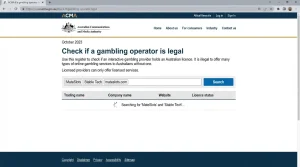
The Australian Communications and Media Authority, known as ACMA, is the country’s primary regulator for online gambling. Its role includes enforcing the Interactive Gambling Act 2001. Where an operator breaches the law, ACMA can issue fines. It can also ask internet service providers to block websites that offer prohibited interactive gambling services to Australian customers, as well as unlicensed services to adults in Australia.
Blocking is an enforcement measure, not a declaration that every website which remains reachable is lawful. Nor does a site’s disappearance establish, by itself, what happened in a particular case. The important point is that Australian enforcement can reach beyond the operator: ACMA may seek to limit access through the networks that connect users to websites. The legal boundary is backed by practical measures.
Inclave casinos in Australia: access and rules
That mechanism reflects a modern compromise. Regulators do not own every doorway through which a website arrives, so they can direct requests toward the infrastructure that carries it. The result is less dramatic than a shuttered casino, but it serves a similar purpose: making a prohibited service harder to reach. A block is an intervention in access, not a change to the game’s rules or its stated return.
The framework also helps separate the operator’s legal position from the player’s. The Act prohibits operators from offering real-money online casino games to people in Australia; it does not explicitly criminalise an individual for using an offshore casino site. That distinction should not be mistaken for an endorsement of such services. It describes where the law places the prohibition, not a stamp of approval for a website or a guarantee about what may happen to an account or funds.
Why payout claims do not settle the issue
A search for the highest payout casino online may begin with a number, but the number answers a different question from the law. It may describe a game’s stated return under its terms. It says nothing about whether the operator may offer that game to Australians. In this market, legality cannot be inferred from a high figure, a familiar name, or a confident claim on a page.
That separation matters because promotional language often compresses several ideas into one attractive phrase. “High payout” sounds like a quality judgment; “available” sounds like a practical fact; neither establishes that an online casino service is lawful in Australia. The legal test concerns the nature of the service and the people to whom it is offered. A payout label cannot move it across the line.
ACMA Enforcement
The Australian Communications and Media Authority (ACMA) can issue fines to breaching operators and request internet service providers to block prohibited gambling websites.
ACMA’s enforcement powers give that line a public, institutional form. The regulator can act against breaches and seek website blocking through internet service providers. The details of any specific enforcement action belong to that action, but the wider framework is clear: online casino games offered for real money to people in Australia are prohibited, and the regulator has tools to respond.
The legal context is therefore not a footnote to payout comparisons. It comes before them. A percentage may be discussed as information about a game, but it cannot turn a prohibited offer into a lawful one. Numbers travel easily across borders. The rules do not.
Why Casino Games Cannot Be Ranked by One Payout Figure
A single payout figure looks like a tidy answer to an untidy question. It suggests that casino games can be placed in a simple order, from generous to less generous, as though every game measured the same thing in the same way. But a percentage attached to one game does not, by itself, tell how it compares with a different kind of game. The figure needs a context.
Return to player, or RTP, is one possible point of comparison when a game states it. Yet the presence of a percentage does not make unlike games equivalent. A slot, a card game and a table game do not necessarily use the same rules, choices or payout structures. Comparing their headline figures without accounting for those differences is less like comparing prices and more like comparing measurements taken with different rulers.
Casino Apps for iPhone in Australia: Legal Guide
The difficulty is partly in the question itself. Asking what casino game has the highest payout sounds as though there must be one clear winner. But “payout” can refer to different things: a published return figure, a particular prize, or what happens during a player’s individual session. A large possible prize is not the same measure as a game’s stated RTP. Nor does an RTP figure describe what any one person will receive. Those distinctions disappear when all the language is compressed into “pays the most”.
RTP can still be useful, but only within limits. It gives a stated return measure for a particular game, rather than a universal score for every game in a casino. Where figures are available, they can provide information about the game to which they belong. They cannot establish that a whole category is better, or settle what a player’s results will be. The percentage is a label for one measure, not a league table.
This matters especially when slot games are folded into a broader comparison. A slot’s stated RTP may look directly comparable with another percentage, but a headline number alone does not explain the game’s structure or how its outcomes are distributed. A high figure cannot tell whether a player’s experience will be steady or sharply uneven; nor can it predict the result of a short session. Those are separate questions, not hidden meanings contained in the percentage.
Do
- Use RTP as a stated measure of a game’s design
- Check the specific version of the game in use
- View payout figures as statistical information
Don’t
- Treat RTP as a guarantee of personal winnings
- Rank different game types by a single figure
- Assume a title has one permanent return rate
There is also a practical wrinkle: a pokie’s RTP can be checked in its information or help screen, often through an “i” or menu icon. That makes the stated figure easier to locate, but does not transform it into a ranking of all casino games. And the same game may be offered in different RTP versions, with the operator selecting which version to run. A figure therefore needs to be read as information about the version in use, rather than as a permanent property of a title across every setting.
The phrase “highest-paying casino games” can also blur the difference between a game’s advertised or stated return and a memorable outcome. A striking win is visible; a return percentage is an abstract measure. People naturally give more weight to the vivid event. That is not a failure of arithmetic so much as a feature of attention: an exceptional result makes a better story than a long-run measure, even though the story cannot stand in for it.
So a meaningful comparison begins by asking what is being compared. Is it a stated RTP, a possible prize, or the experience of a particular session? Are the games being measured on the same basis, and is the figure tied to the version actually offered? Without those distinctions, claims about the highest payout online casino games make unlike information look interchangeable.
No universal champion follows from one number. A payout figure can describe a specific game on stated terms; it cannot rank every game type, predict individual results, or turn a broad category into a reliable promise. A comparison is only as sound as the question behind it.
Best Casinos Not on BetStop in Australia
A High-Paying Label Is Not a Safety Guarantee
A casino described as high-paying is making a claim about returns, not a statement about how it treats people or whether it may legally serve them. The distinction is easy to blur. A prominent payout label can sit beside language about responsible play, identity checks or help for people experiencing gambling harm; none of those neighbouring claims proves the others. A favourable-sounding number is not a safety certificate.
That matters particularly in Australia, where the legal position is not a matter of branding. The Interactive Gambling Act 2001 prohibits operators from providing real-money online casino games to people in Australia. A foreign or offshore licence does not make an online casino licensed in Australia. Nor does a service’s use of Australian support information, responsible-gambling language or local payment options change that position. Presentation can be polished. The legal line remains.
Safeguards still deserve attention as a separate subject. Licensed gambling operators are subject to responsible-gambling requirements under the Act. Those requirements concern how a service is expected to operate; they are not a method for identifying a legal online casino in Australia. A specialist review has described online casino deposit limits that players may set over daily, weekly or monthly periods. That is a report about the controls it discusses, not evidence that such settings are an established feature of every service, or that a service offering them is authorised to provide online casino games here.
Consumer Protection
Unlicensed gambling services lack Australian consumer protections, meaning laws may not assist if winnings are withheld.
The same distinction applies to information about harm. Reputable platforms provide material on gambling-related harm and direct people to professional support services across Australia. Such signposting can be useful in its proper context. It does not establish that the platform itself is lawful, that its claims about paying well are accurate, or that it is suitable for a person’s circumstances. A support link is not a licence in disguise.
The phrase “highest paying online casino” therefore bundles together questions that ought to stay separate. How a game describes its return is one question. Whether a service has responsible-gambling controls is another. Whether it may offer online casino games to Australians is a third. A service can make attractive claims in one area while leaving the others unresolved. The word “highest” adds confidence, not proof.
For a person weighing up an offshore casino, the practical risk is not confined to whether a game returns money over time. Unlicensed gambling services lack Australian consumer protections, and Australian laws may not assist if winnings are withheld. A claim about a generous return cannot repair that gap. Nor can a responsible-play message establish that the service will respond fairly when a dispute arises.
Safe Online Casinos in Australia: Legal and Safety Checks
Access through a virtual private network does not alter the legal status of an online casino. Using one to reach a service may also lead to voided winnings, account closure and loss of a deposit. Those are material risks, not technical footnotes. A change in apparent location does not turn a prohibited service into one authorised for Australians.
There is a quiet irony in the way the language of care can be arranged around a claim of abundance. Limits and support information speak to the consequences of gambling; a payout label speaks to expected game returns. Neither should be made to stand in for the other, and neither makes an otherwise prohibited offer lawful. The distinction is less glamorous than a ranking. It is more useful.
Slot Machine Payouts Depend on the Version in Use
A slot’s title can look like a fixed identity: one name, one set of reels, one familiar place in a game catalogue. Its stated return, however, need not belong to every instance carrying that name. Providers may make a game available in several RTP configurations, while the operator decides which configuration to run. The title alone does not settle the matter.
That distinction complicates any attempt to identify a single highest-paying slot machine. A comparison based only on game names may place unlike versions side by side as though they were identical. Even when the artwork and play appear familiar, the version selected for a particular service may differ from another version of the same game. The figure attached to one configuration cannot simply be carried over to all others.
The choice is made at the operator level. A provider can supply more than one return setting for a game; the service offering it selects which setting is active. This means a game’s general reputation or a figure associated with its title is not, by itself, proof of the configuration running in a particular instance. A product name is not a universal specification.
Why game versions matter
Providers may offer several RTP configurations for a single game title. The operator chooses which version to run, meaning the payout rate can differ between services for the same game.
That is why lists of high-paying online slots can give a tidier answer than the underlying arrangements allow. They may suggest that a game has one permanent return, when the relevant detail is which version has been selected. Without identifying that version, a claim about the title as a whole risks collapsing different configurations into one. The neat ranking conceals the choice that matters.
For a comparison to be meaningful, it has to concern the version actually in use, not merely a familiar game name. This is a narrower question than which slot is said to pay best in general. The same title may represent different return settings across services, because operators do not necessarily run the same configuration. A figure tied to one service therefore should not be treated as a property shared by every appearance of that title.
The arrangement also places a limit on what a provider’s name can tell anyone. Knowing who made a slot does not establish which available version an operator selected. Nor does the presence of the same game elsewhere establish that the configuration is the same. The relevant unit is not just the game, but the game in the version chosen for use.
A highest-payout claim therefore needs more than a title to be informative. Until the active version is clear, the title may identify the game, but not the return configuration behind it. Familiarity is not a setting.
Pokies Open Near Me in Australia: Casino Hours
Pokies and the Information Screen Behind the ‘i’
A pokie’s return figure is not always displayed on its opening screen. It is more often tucked into the game’s information or help area, among the quieter pieces of text that sit outside the reels and play controls. The small ‘i’ icon is a common doorway; in some interfaces, the same material is gathered under a menu.
Finding it is a matter of opening the game’s own information panel and looking for the RTP entry. The label may appear alongside other game details, rather than as a prominent number on the main screen. That placement can make the figure easy to miss, particularly when the interface gives far more visual space to symbols, animations and buttons. The information is there, but it does not always announce itself.
The exact route depends on the screen design. An ‘i’ may open a help page directly, while a menu may lead to a further information option. On a smaller display, icons or headings can be less obvious, and the panel may require scrolling. Those are interface details, not a different method of determining the stated return: the relevant place remains the game’s information or help screen.
This makes the game itself the useful starting point when checking a claim about a particular pokie. A promotional description or a general page about “high-paying” games may not show the figure attached to the version currently presented. The in-game information screen is where the stated RTP can be checked. No ranking is needed to locate it.
There is a small cultural irony in the arrangement. The most conspicuous parts of a pokie are designed to hold attention; the detail that describes the game’s stated return is often behind an unobtrusive symbol or menu. A few taps, then.
Checking RTP
Locate the Icon
Find the small ‘i’ icon or the menu button on the game interface.
Open Information
Click the icon to open the game’s help or information panel.
Find the Entry
Scroll through the text to locate the RTP (Return to Player) percentage entry.
The practical check is simple: open the information or help screen, look for the ‘i’ or menu icon, and find the RTP entry. If the relevant panel is not immediately visible, explore the game’s own menu rather than treating a figure elsewhere as though it were displayed there. Interface layouts vary, but the information screen is the place to look.
Reading a Percentage Without Mistaking It for a Promise
A payout percentage is game information, not a forecast for the next session. It describes a stated return associated with the game; it does not say what any one player will receive, or when. Treating it as a promise turns a statistical description into something it cannot be.
That distinction matters when claims are arranged as though the “highest payout percentage” settles the question of value. A figure can be useful for understanding a game’s stated terms, but it cannot guarantee a result or make one session resemble the return described. The label remains a description, not a debt owed to the player.
There is another complication: the same title can exist in several RTP versions. The operator selects which version to run, so a percentage attached to a game name should not automatically be assumed to apply to every version of that title. The name alone is not the full information.
This is why searches for slot machines with the highest payout percentages can suggest a certainty that the figures do not provide. A higher stated percentage is not a promise of a better individual outcome, and it does not establish that a particular version is in use. Nor does the number transform a game into a reliable source of income. Dry arithmetic, not prophecy.
Australian mobile casinos: access, payments and play
The percentage belongs to the game’s information, and should be read in that limited way. A figure may help describe the stated return, but it cannot tell a player what will happen in a particular stretch of play. Even a clear label cannot remove uncertainty from the result.
The practical distinction is modest but important: a percentage can inform how a game is described; it cannot guarantee how it will pay. Treating the number as a personal assurance gives it a meaning it was never equipped to carry.
A Casino’s Payout Rate and the Withdrawal Process Are Different Things
A game’s stated return and a withdrawal are measurements of different things. The return figure describes the game; it does not describe how an operator handles a request to send funds out of an account. A service described as an online casino with a high payout rate may still require identity checks before it processes withdrawals. The wording joins two separate questions, not one assurance.
Withdrawal processing begins after a request is made, but identity verification may stand between that request and the funds being released. Casinos conduct know-your-customer checks and require identity verification before withdrawals. This is an account procedure, not a feature of the game and not evidence that its stated return is higher.
The documents commonly requested serve distinct purposes. Photo identification helps establish who holds the account. Proof of address connects that identity to a place of residence. Proof of ownership of the payment method used helps establish that the payment instrument belongs to the account holder. Together, these checks are meant to verify identity and payment ownership; they do not measure a game’s performance.
Identity Verification
Casinos require KYC (know-your-customer) checks, such as photo ID, proof of address, and proof of payment ownership, before processing withdrawals.
That distinction matters when claims about an online casino with the highest payout rates are read alongside claims about withdrawals. A game return cannot establish how a request will be handled, while a completed identity check cannot establish how much a game returns. One belongs to game information; the other to account administration.
The process also has a human consequence: a withdrawal request may bring paperwork into a relationship that, until then, seemed to consist mainly of a screen and a balance. That requirement is not a payout rate, whatever the surrounding promotional language suggests. Different ledgers.
Legitimacy, Encryption and Identity Checks
Security measures address particular risks; they do not settle every question raised by a casino’s claims. SSL encryption is used to protect sensitive information and transactions as they move between a user and a service. It concerns the handling of data, not the return rate of a slot or the likelihood of a winning session. A high-paying label, however confidently presented, says nothing about whether personal details are being transmitted securely.
Casino apps for Android in Australia: access guide
Encryption has a limited job. It can help shield information in transit, but it does not establish who controls a site, how that organisation handles information after receiving it, or whether the service is authorised to operate in Australia. Those are separate questions. A security feature is not a certificate of general trustworthiness.
Identity checks serve another purpose. Casinos conduct know-your-customer procedures, commonly shortened to KYC, and require identity verification before allowing withdrawals. That means a request for funds may be preceded by a process in which the account holder’s identity must be confirmed. The check is about establishing who is making the request, rather than determining whether a game pays generously.
These measures can therefore be read as concrete, but narrow, signals: SSL encryption is intended to safeguard transactions and sensitive data; KYC checks verify identity before withdrawals. Neither one proves that a service is reputable in every respect, and neither changes the meaning of a game’s stated payout information.
Secure Online Casinos in Australia: What Security Means
The distinction matters because “legitimate” is often made to carry too much. A secure data connection and an identity check describe specific procedures. They do not, by themselves, answer broader questions about a casino’s conduct or status. Security is a practice, not a verdict.
Payout Rate Is Not the Same as Payout Speed
A game’s payout rate describes its stated return over play; it does not measure how quickly money reaches a bank account. The words overlap in ordinary conversation, but they refer to separate processes. A high payout rate cannot make a payment arrive sooner, and a rapid transfer says nothing about the game’s return.
Payment timing begins after a withdrawal request is approved and depends partly on the method used. A specialist review describes PayID and some e-wallets as potentially quick after approval, while bank transfers and card payments may take several business days. Those are descriptions of payment routes, not a universal timetable: processing arrangements can differ.
Instant Withdrawal Casinos in Australia: What to Know
The same review notes that PayID transfers run through the New Payments Platform and may clear quickly, sometimes within minutes once released. The distinction between release and arrival matters. A transfer may move promptly through the payment network only after the service has approved it; the network cannot settle a request that has not yet been released.
This is why “fast payout” is an ambiguous phrase. It may refer to a game returning winnings during play, an operator approving a withdrawal, or a payment provider completing the transfer. Only the first concerns the game’s payout rate. The others concern administration and payment handling.
The language of casino promotion often compresses these stages into one reassuring promise. The arithmetic does not. A percentage belongs to the game; a transfer time belongs to the route taken after approval. Neither is evidence of the other.
Which banking methods are available for deposits and withdrawals?
Methods may include PayID, e-wallets, bank transfers and cards. POLi is mainly for deposits, while card withdrawals may be slower or unavailable; check the payment options for the service you use.
What are the legal consequences for Australian players using offshore casinos?
The Interactive Gambling Act 2001 targets operators providing prohibited online casino games, rather than explicitly criminalising individual players. ACMA can fine operators and request that internet providers block access to prohibited services.
What documents might be needed for verification?
You may be asked for photo ID, proof of address and proof that you own the payment method used. Casinos commonly require identity checks before withdrawals.
How long should a withdrawal take from a secure casino?
After approval, PayID and some e-wallet withdrawals can be quick, while bank transfers and cards can take several business days. PayID transfers often clear within minutes once released.
What responsible gambling tools and support services are available?
Licensed operators provide deposit limits that players can set daily, weekly or monthly. Reputable platforms also share information about gambling-related harm and direct players to professional support services in Australia.