Casino Dice Games in Australia: Rules and Formats
 Available in AU
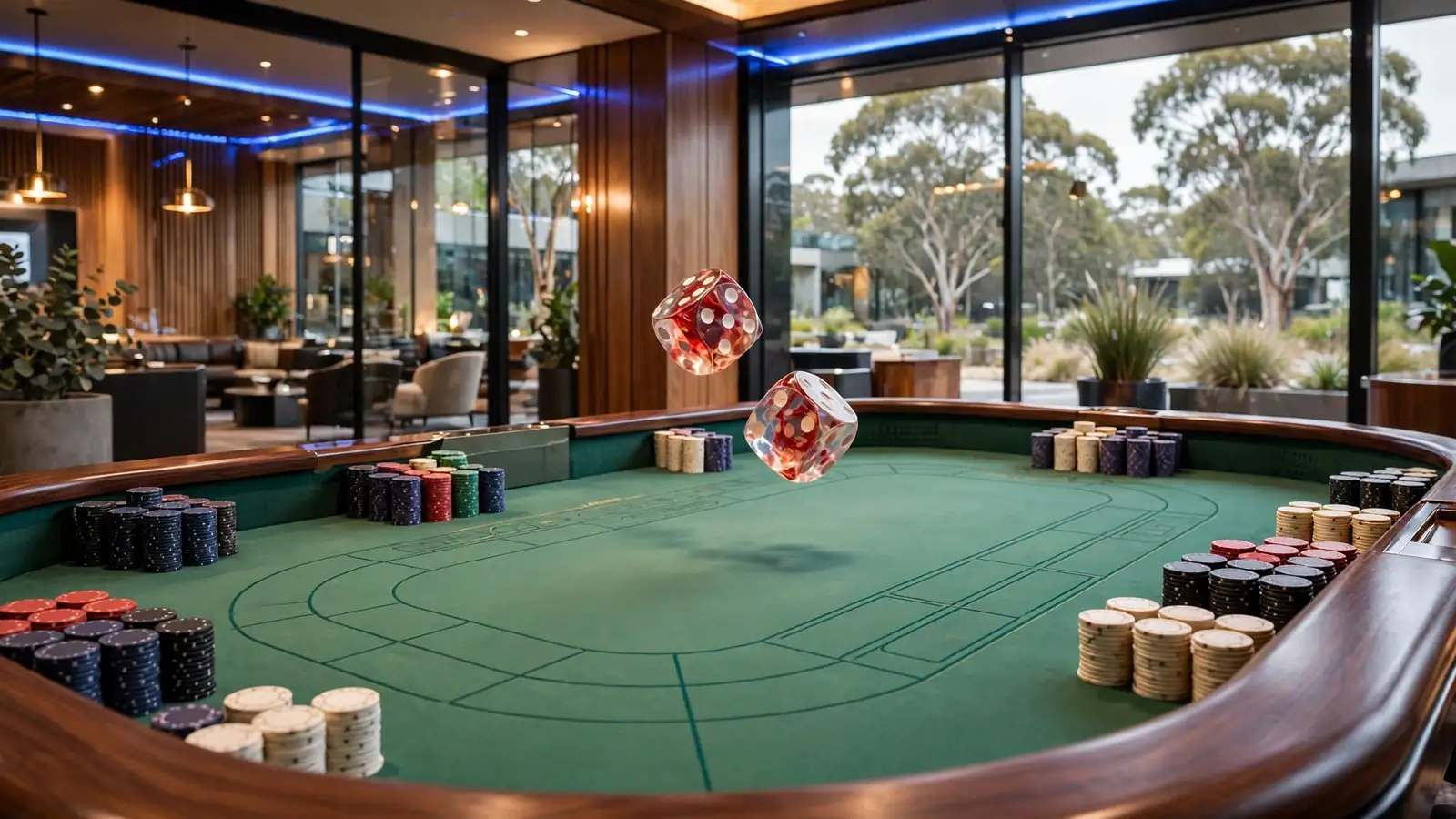
Table of content
Casino dice games depend on rolls that affect wagers, from traditional craps tables to online formats and live play.
What Counts as a Casino Dice Game?
A casino dice game is one in which dice help determine the result that matters: whether a wager wins, loses or is resolved another way. Their role is functional, not ornamental. The player may throw them, a dealer may handle them, or a digital system may produce a roll; in each case, the numbers or combination shown must affect the game’s outcome.
That distinction sounds simple, but casino imagery often blurs it. Dice printed on a card, shown on a screen or worked into a game’s theme do not, by themselves, make that game a dice game. If the result is decided by cards, a wheel or some other mechanism, and the dice have no bearing on the wager, they are decoration. A prop is not a rule.
The reverse is also true: a game need not resemble a traditional casino table to count. What matters is whether dice outcomes are built into its central process. A player might make a choice before a roll, or the game might compare the rolled result with a target or condition. The surface can vary; the defining feature remains the dice’ influence on what happens.
For a casino dice game in Australia, it is worth checking the available operator information before choosing where to play. These verdicts highlight the specific details provided for each option.
1. SpinsUp
License: Curacao Gaming Control Board OGL/2023/174/0082 (Dama N.V.) SpinsUp is listed with a Curacao Gaming Control Board licence, OGL/2023/174/0082, held by Dama N.V.
2. LevelUp Casino
License: Curacao eGaming OGL/2023/174/0082 (Dama N.V.) · Min. deposit: A$15 LevelUp Casino is listed with a Curacao eGaming licence, OGL/2023/174/0082, held by Dama N.V. Its minimum deposit is A$15.
3. MrPacho
Payout speed: crypto 30-120 minutes, fiat 24-72 hours · Min. deposit: A$30 MrPacho lists crypto payouts in 30–120 minutes and fiat payouts in 24–72 hours. The minimum deposit is A$30.
4. Ricky Casino
Payout speed: crypto under 1 hour, PayID 1-3 business days · Min. deposit: A$20 (A$30 to qualify for the bonus) Ricky Casino lists crypto payouts in under an hour and PayID payouts in 1–3 business days. The minimum deposit is A$20, or A$30 to qualify for the bonus.
5. SkyCrown
License: Tobique Gaming Commission · Payout speed: crypto ~10-15 minutes, fiat 1-5 days · Min. deposit: A$30 SkyCrown is listed with a Tobique Gaming Commission licence. Its stated payout times are around 10–15 minutes for crypto and 1–5 days for fiat; the minimum deposit is A$30.
6. Kingmaker
Payout speed: crypto ~90 minutes, fiat 1-5 days · Min. deposit: A$30 Kingmaker lists crypto payouts at around 90 minutes and fiat payouts in 1–5 days. Its minimum deposit is A$30.
7. Neospin
License: Curacao Gaming Control Board OGL/2023/176/0095 (Hollycorn N.V.) Neospin is listed with a Curacao Gaming Control Board licence, OGL/2023/176/0095, held by Hollycorn N.V.
8. GoldenCrown
License: Curacao Gaming Control Board OGL/2023/176/0095 (Hollycorn N.V.) GoldenCrown is listed with a Curacao Gaming Control Board licence, OGL/2023/176/0095, held by Hollycorn N.V.
9. Thor Casino
License: Curacao – Antillephone N.V. (Versus Odds B.V.) · Min. deposit: EUR 20 Thor Casino is listed with a Curacao licence from Antillephone N.V. (Versus Odds B.V.). Its minimum deposit is EUR 20.
10. Wild Tokyo
License: Curacao · Payout speed: crypto 30-60 minutes, fiat 1-5 days · Min. deposit: A$10 Wild Tokyo is listed with a Curacao licence. It lists crypto payouts in 30–60 minutes, fiat payouts in 1–5 days, and a minimum deposit of A$10.
So, when people ask what the dice game in a casino is, there is no single answer. The category includes games with different structures, united by the same basic device: dice supply information that determines an outcome. Craps is a familiar example, though the wider idea is not confined to it. The name on the table matters less than the role assigned to the dice.
This definition also separates casino dice games from ordinary games that happen to use dice. Dice in a family board game may move a token rather than settle a wager; that alone does not make the game a casino format. Context counts, as does the relationship between the roll and the stakes.
The test is therefore practical: remove the dice, and would the game’s result change or become impossible to establish? If not, the dice are probably scenery. If the roll is part of how the result is decided, dice are doing the work. Simple enough.
Casino Dice Games, From the Table to the Screen
A casino dice game is not defined by a particular room, table or set of house rituals. It is a family of games in which dice supply the decisive uncertainty: their fall determines an outcome, changes what is at stake or sets the next phase in motion. The same simple objects can be presented in very different surroundings, from a crowded felt table to a quiet digital display. The category travels well. The experience does not travel unchanged.
At a physical casino table, dice are public objects. Players can watch them handled and thrown; other people’s attention gathers around the same moment. The table gives the game a visible centre, and its layout makes an otherwise abstract set of rules tangible. Marks, spaces, chips and gestures all help turn chance into a shared event. Even someone who is not taking part can follow the drama of a roll. A small cube, briefly airborne, holds the room’s attention.
Pokies & Games: Slots and Casino Game Guides
That public quality is part of the appeal, but it is not the whole of the game. A casino dice game depends on rules that translate a throw into an outcome. The dice may be visible to everyone, yet the meaning of their result comes from the structure around them. The objects are familiar; the systems are not always obvious. A table provides a setting in which those systems can be watched and learned, without making every game the same.
The screen changes the frame. Instead of a shared table, a digital version presents dice through graphics, animation and interface elements. The result may still be represented by dice, but the surrounding cues are selected and arranged by software. There is no physical felt to gather around, and no roomful of strangers reacting in the same instant. The screen compresses the game into a private visual field, where attention is directed by what appears on it.
That change can make the underlying action seem cleaner. A digital display can show a result without the interruptions, movements or social noise of a real table. It can also make the experience feel less embodied: the player sees an image of dice rather than watching objects move through space. The distinction is not simply between old-fashioned and modern play. It is between kinds of presence. One is located in a room, among other people; the other is mediated by a screen.
There is a cultural difference in that shift. A table game makes its conventions public. People see who is watching, who is waiting and how the group responds. A digital format can retain the symbolic language of casino play while removing much of its human setting. The dice remain recognisable, but the social scene around them becomes optional, or disappears altogether. The screen offers the image of an event without requiring a crowd.
This is why “casino dice” can describe more than a single game or one standard way of playing. It points to a broad idea: chance expressed through dice within a casino setting. Some versions place the dice at the centre of a communal table; others use them as part of a self-contained digital presentation. Their shared element is not the décor, the pace or the company, but the role assigned to the dice. The category is wider than any one table.
Crash casino games in Australia: access and law
The digital version also makes the boundary between representation and action more noticeable. On a table, a throw has a physical cause visible to the people gathered there. On a screen, the player encounters a displayed result. Both can be understood as ways of presenting a dice-based game, but they ask for different kinds of trust and attention. A physical roll invites observation of an object in motion; a digital one invites attention to an interface and its account of the result. Neither setting can be reduced to the dice alone.
In Australia, any discussion of online casino play needs to keep that distinction clear: describing a screen-based format is not the same as suggesting that real-money online casino services may lawfully be offered to people here. The subject can be considered as a change in presentation, not as an invitation or route to play. A screen is a medium, not a permission slip.
The table and the screen therefore belong to the same broad conversation, but they tell different stories about casino play. The table makes chance communal and visible; the screen makes it portable in form, while narrowing the world around it to what the interface shows. The dice may look unchanged. Their setting has changed considerably.
The Different Games That Put Dice to Work
Dice do not dictate one kind of casino game. Their role depends on what the rules ask them to represent: a total, a particular face, a combination, or even a set of symbols. That flexibility gives casino games with dice a broader character than the familiar image of a crowded craps table suggests.
In some games, the dice are chiefly number-makers. Sic bo, for instance, uses three dice and invites wagers on outcomes such as totals or whether particular numbers appear. The appeal lies in reading a small cluster of possibilities rather than following a single, extended table-game narrative. A roll settles the bets; the dice are the whole event, not props in a larger performance.
Sic bo
Uses three dice where players wager on totals or the appearance of particular numbers.
Chuck-a-luck
Three dice are shaken in a cage, with bets placed on whether a chosen number appears.
Dice poker
Faces stand in for card values or suits, using dice to echo traditional card hands.
Crown and Anchor
Dice are marked with emblems instead of numbers, and wagers concern which symbols appear.
Other formats make the individual faces matter. In chuck-a-luck, three dice are shaken in a cage, and bets can be placed on whether a chosen number appears among them. The result is less about adding up a total than noticing how often a face turns up. The cage gives the game a distinct visual identity, a mechanical little theatre in which the dice tumble before landing in view.
There are also dice games that borrow the language of cards. In dice poker, faces stand in for card values or suits, and combinations take the place of hands. It is a reminder that dice can be more than random number generators: they can act as a compact set of symbols, allowing a game to echo another familiar form without using a deck.
Two-dice games make another kind of pattern possible. Their outcomes can be read through the relationship between the pair as well as through their sum. Some casino table games build on that simplicity; others add several betting choices around the same roll. The precise rules vary, so a shared number of dice does not mean a shared game.
A separate tradition uses dice marked with images or symbols instead of conventional numbers. Crown and Anchor is one example: the faces carry emblems, and wagers concern which symbols will appear. Here the dice function almost like a miniature set of cards, but their shared roll keeps the outcome immediate and public.
Mines casino game in Australia: rules and checks
These differences matter because “a casino game with dice” describes a family, not a rulebook. A game may make the total central, track the appearance of a selected face, translate symbols into combinations, or use dice to imitate card play. Some formats are designed around a table and a host; others reduce the game to a compact sequence of bets and a roll. The equipment may be similar, but the question each game asks of the dice changes.
Craps is the best-known table example, though it is only one member of this varied company. Its social customs and table structure deserve their own account. The wider category is less uniform than it looks: a few small cubes can carry several quite different ideas of chance.
Craps: The Table, the Dice and the Ritual
Craps is often recognised before its rules are understood. The table announces itself: broad, angled towards the players, its felt marked with betting areas that turn a flat surface into a small public theatre. At its centre are the dice. Around them, people lean, watch, call out, or wait for a moment when the action seems to gather around one pair of hands.
That arrangement makes craps unusually social among casino table games. The table does not simply hold the game; it gives the group a shared focus. Players may make separate choices, but the dice create a common pause. Attention travels from the shooter to the felt and then across the faces gathered around it. A result belongs to the game, yet the suspense is collective.
Craps is uniquely social among casino table games because the dice create a common pause and a shared focus for all players and spectators.
The rituals are modest but legible. Dice are offered to the shooter, handled briefly, and sent across the table. Players may call encouragement or follow familiar gestures, while staff keep the action moving and the playing surface orderly. These habits can look like superstition from outside. Within the room, they are also a way of taking part: small ceremonies around an outcome no one at the table can command.
The dice themselves matter because they are visible and shared. In many games, a result appears on a screen or is announced by a dealer; in craps, the objects that produce the result pass through the players’ space. The table makes that passage public. There is no private reveal, no solitary screen. Everyone can see the same objects, and everyone waits on the same landing.
This is why a casino craps table can feel louder and more animated than a table where play is mostly individual. The layout gathers people close, while the changing rhythm gives the crowd reasons to respond together. Even those who are not throwing may feel implicated in the moment. The game has made spectators into participants, at least for the duration of a turn.
The table also imposes a kind of order. Its printed zones distinguish one kind of wager from another, and the staff’s presence gives the crowd a visible centre of authority. The felt may look busy, but it is not casual space. The ceremony works because there is a boundary between the players’ side and the organised movement of the game.
That boundary is part of craps’ appeal and part of its theatre. The player holding the dice receives a brief, conspicuous role; the crowd supplies a chorus. Yet the scene should not be mistaken for control over chance. The gestures may give a game texture, but they do not make its outcome more predictable. Gambling can cause serious harm, particularly for vulnerable people, and participation is for adults aged eighteen or older.
Live Baccarat Online in Australia: Rules and Risks
Craps is therefore more than dice placed on a table. It is a social arrangement built around watching them: a marked surface, a temporary performer, and a crowd ready to share the silence before the room reacts. A small stage.
Reading the Rules Before the Dice Roll
A dice game’s rules do more than describe what happens after a throw. They decide which outcomes count, when a round begins and ends, and how a result becomes a win, a loss or a draw. The dice may supply the uncertainty; the rules give that uncertainty a shape.
That distinction matters because familiar words can conceal different arrangements. A rulebook may define an outcome by the total shown, by a particular face, or by the relationship between successive throws. The same-looking roll can therefore carry different meanings in different games. The game’s name is not a substitute for its terms.
Rules also set the boundaries of a round. They establish whether a result is final at once or depends on what follows, and whether a later event can change the status of an earlier one. These details may seem clerical beside the bright instant of a roll. They are where the game’s real structure lives.
Then come the conditions attached to a wager: what must happen for it to succeed, how a tie is handled, and what happens when no listed outcome applies. A clear account should explain the relationship between the wager and the result, rather than rely on a label that sounds self-explanatory. “Winning” is not a universal category; it is a conclusion reached under a particular set of rules.
The language of the rules deserves the same attention as their headline description. Terms such as “round,” “point” or “push” can have technical meanings within a game, and a short definition may govern more than its length suggests. Ambiguity is not a mysterious property of dice. It is a property of wording.
Live Blackjack Online in Australia: Legal Limits
This is why the idea of the best casino dice game cannot be settled by a title or a striking presentation. A game may feel simple while its settlement conditions are intricate; another may look elaborate but state its outcomes plainly. The useful comparison is not a universal ranking, but how intelligibly each game explains what the dice can decide and what follows from that decision.
A careful reading also separates the rules of the game from surrounding claims about it. Descriptions and tables can summarise, but the controlling terms are those that specify how results are resolved. Where two explanations appear to conflict, the uncertainty should be treated as meaningful, not waved away as fine print.
Rules are not an ornament around chance. They are its civic architecture: the quiet arrangement that turns a random event into an agreed result. Read them first. Then the dice speak.
Playing Dice Games Online: What the Format Changes
Moving a dice game onto a screen changes the setting before it changes anything else. There is no felt surface, no hand reaching across a table, no small crowd following the same movement. Instead, the game is arranged inside a frame: dice, buttons, labels and a result, all made legible through an interface. The physical object becomes an image that can be animated, enlarged or reduced to a symbol.
That translation can make a game easier to inspect. A screen can keep the current state visible and place prompts close to the controls they describe. It can also remove the small uncertainties of a shared table: whether the dice have settled, whether everyone has seen the result, whether a gesture was part of the game or merely habit. The software presents a finished sequence. Its tidiness is useful, though not especially sociable.
A different rhythm
At a physical table, the pace is partly human. Someone handles the dice; other people watch, react or wait. A digital version turns those pauses into interface time. A player may be able to start a new round quickly, or the game may impose a short animation before showing the outcome. Either way, the rhythm is designed rather than negotiated among people in a room.
Pokie Machines to Play in Australia: Rules and Features
That distinction affects attention. Repeated movements can become familiar: select an option, activate a control, watch the dice appear, read the result. The screen makes this cycle compact and easy to repeat. There is less ceremony around each outcome, and fewer social signals to interrupt the sequence. The convenience of a clear button is also the convenience of another clear button.
Some digital formats display a rendered roll; others may communicate the result more simply. Animation gives the eye something to follow, but it is still a presentation of an outcome, not evidence that the dice have acquired a physical history. The image can suggest weight, bounce and collision. Those impressions belong to design. The interface is a stage, not a felt table.
What the screen can show
A digital layout can place information beside the action rather than around a large table. Controls may be labelled, the result may remain on screen, and a compact view can reduce the need to track several people’s movements. These are changes in presentation, not guarantees that a game is self-explanatory. A crowded screen can obscure as readily as it can clarify, particularly when decorative effects compete with the parts that matter.
Sound and motion also alter the mood. A click can mark a selection; a rattle can make an animated throw feel more tactile; a pause can hold attention before the result appears. None of these effects changes what a player is seeing: a digital representation. Their purpose is to give the sequence a shape, and sometimes to make a routine action feel momentous.
Best Video Slots in Australia: Games and Access
A free-play or demonstration setting, where one is offered, can be understood as a way to encounter an interface without treating its display as a promise about real outcomes. It may show how controls are arranged or how a result is presented. It cannot reproduce the social pressure of a busy table, and it should not be mistaken for a measure of what later play would feel like. The screen can imitate a room’s gestures. It cannot supply the room.
Distance and attention
Online play also changes how attention is divided. A table gathers people around one visible event; a screen sits among other tabs, alerts and interruptions. That makes the experience more private, but not necessarily more focused. Without the presence of others, a round can feel less like a public occasion and more like a sequence managed alone.
The most useful distinction is therefore not between old and new technology, but between kinds of presence. A physical game makes the dice part of a shared space. A digital one makes them part of an interface, where movement, sound and layout stand in for touch and company. The outcome may occupy the same place in the game, but the surrounding experience has been redesigned.
Australia’s Rules for Offshore Online Casino Services
The law draws a firm line between the person who uses an offshore gambling site and the business that offers it. Under the Interactive Gambling Act 2001, operators cannot provide real-money online casino services to people located in Australia. The restriction covers casino-style play delivered over the internet; a dice game does not acquire a different legal status simply because its rules are simpler or its presentation resembles a small game rather than a full casino table.
The distinction matters. Players are not criminalised for using offshore sites, but that does not make the services lawful to offer in Australia. Offshore casinos may accept Australian payments while holding licences issued elsewhere. A foreign licence does not replace permission under Australian law, and the site’s willingness to take a deposit does not establish that it may legally provide the game to someone in Australia. Payment access and legal status are separate questions.
Legal Prohibition
Under the Interactive Gambling Act 2001, operators are prohibited from providing real-money online casino services to people located in Australia.
That separation is easy to miss because the service can look ordinary from a screen: a balance, a game, a button and an account. Yet the law addresses the operator’s conduct, not the visual neatness of the interface. Online casino games, including dice games offered for real money, belong to the prohibited-service category when supplied to customers in Australia. A digital version is still a service.
Enforcement and website blocking
The Australian Communications and Media Authority, usually called ACMA, is the federal regulator responsible for enforcing the Interactive Gambling Act and monitoring compliance with national interactive gambling laws. Its role is not limited to issuing statements about the rules. When it identifies a prohibited service or advertising for one, it can ask Australian internet service providers to block access to the relevant website.
Blocking is an enforcement measure, not a declaration that every offshore gambling site has disappeared from view. The point is that access can be restricted following regulatory action, and an address that once loaded may later become inaccessible through Australian providers. Operators may also withdraw from the market rather than continue to offer a service in the face of enforcement. The boundary is maintained through practical measures as well as legislation.
ACMA reports that, following enforcement actions, it has blocked more than 1,455 illegal gambling and affiliate websites since November 2019. The count includes affiliate sites as well as gambling services, so it should not be read as a tally of casino operators alone. It shows the scale of website-level intervention, not the number of dice games or individual players involved.
There is a discrepancy in reported figures for services that have left the Australian market. One figure says more than 210 illegal services have withdrawn since ACMA began enforcing the rules in 2017; another gives the total as more than 190. Those versions do not agree, so neither should be presented as an exact settled count. Both describe withdrawals following the start of enforcement, while the separate website-blocking figure records a different kind of action.
3-Reel Slots in Australia: Bonus and Format Guide
A boundary aimed at providers
The Act’s approach places the principal legal obligation on those supplying prohibited interactive gambling services. That is why the player’s position must not be confused with the operator’s. Australians are not criminalised merely for playing on an offshore site, even though providing real-money online casino games to people in Australia is restricted. The difference is consequential: a prohibition on supply is not the same thing as a criminal penalty imposed on every person who encounters that supply.
Nor does a site’s offshore licence alter that basic division. Such a licence may govern the operator in another jurisdiction, but it is not an Australian authorisation to offer casino games here. The fact that an online casino accepts Australian payments can make the transaction appear routine; it does not change the law that applies to the service. A border is not erased by a payment screen.
Advertising is part of the same regulatory landscape. Promotion of real-money online casino services to Australian audiences is prohibited, alongside the restriction on providing those services. ACMA can seek website blocking where a site provides prohibited interactive gambling services or advertises them in Australia. This is why apparently separate pages—one for play, another for referral or promotion—can still fall within the enforcement picture.
None of this turns the law into a guarantee that every prohibited site will be inaccessible at every moment. It describes the rules and the available enforcement response: the service is restricted, the regulator can pursue compliance and request blocking, and offshore status does not itself supply local permission. The legal distinction is plain; the internet’s geography is less so.
The broader public concern is not only formal compliance. Gambling can cause serious harm to vulnerable people, while the online setting can make a commercial service feel detached from its consequences. Australian law treats the supply of online casino games as a matter for national regulation, rather than leaving the question to the terms displayed by an overseas operator. That is a deliberate boundary, not a matter of interface design.
Strategy, Chance and the Limits of Control
The word strategy carries a reassuring suggestion: that careful thought can turn uncertainty into command. In a dice game, it can mean choosing how much risk to accept, setting a stopping point or declining a wager whose terms are unclear. It cannot make a random result obey intention.
5-Reel Slots in Australia: RTP, Rules and Free Play
That distinction matters because casino games that use dice can invite the eye to find patterns in what is, in effect, a sequence of separate outcomes. A run of similar results may feel like evidence that a change is due. A previous roll may seem to have “used up” an outcome. Neither feeling gives the next throw a memory. The mind is an accomplished storyteller; chance offers it very little plot.
A casino dice strategy, then, is less a route to a win than a way of deciding what participation means. A fixed spending limit can prevent a brief diversion from becoming an open-ended attempt to recover losses. Pausing can interrupt the impulse to increase stakes after disappointment. These choices affect exposure and conduct, not the underlying odds. They are boundaries, not levers.
Nor does a confident manner alter the mathematics. Knowledge of a game can clarify what a wager means and how its outcome is assessed, but familiarity is not influence. The distinction is easy to blur at a busy table, where a ritual, a call or a dramatic throw can make chance seem almost negotiable. It remains chance.
The same caution applies to systems built around observing sequences or varying stakes. A plan may organise decisions, but it cannot guarantee a favourable result or remove the possibility of losing. When a system is judged by its most memorable successes, ordinary failures tend to disappear from the story. Convenient arithmetic.
There is also a social pressure in the language of skill. Calling a loss a mistake can imply that a better player would have controlled the outcome; calling a win proof of expertise makes luck sound like a credential. Neither conclusion follows from a single result. In a dice game at a casino, judgement belongs chiefly to the choices made around play: whether to take part, how much uncertainty to accept and when to stop. The dice retain the final word, and they do not explain themselves.
Limits of Control
Strategy in dice games manages risk and participation, but it cannot influence the random result of a roll.
Live Dice and the Human Table
A live dice table makes people part of the image, not merely the audience. A dealer handles the equipment, announces proceedings and waits while the table’s attention gathers around a result. In a streamed format, cameras carry that scene to a screen; the host’s gestures and pauses supply a human rhythm that a purely automated game lacks. The table becomes a small performance, even when its audience is scattered and unseen.
That difference is more than decoration. An automated display can present outcomes with little social texture: numbers appear, animations play, and the game moves on. A live host gives the same interval a face and a voice. There is room for acknowledgement, routine and the faint ceremony of everyone watching the same moment. Yet a camera does not recreate a shared room. The participants may see the same table without occupying the same social space.
The phrase “live dice” can therefore mean two things at once: dice handled in view of a camera, and a staged impression of company. The first is tangible; the second is carefully mediated. Framing, sound and the dealer’s presence make a distant event feel immediate, but they do not turn remote viewers into a crowd gathered shoulder to shoulder. The human element is real, though bounded by the screen.
That boundary matters in Australia, where the presence of a live dealer on a screen should not be mistaken for permission to access a real-money online casino. Format and legality are separate questions. The live table describes how a game is presented, not whether an operator may lawfully offer it to people in Australia.
At its most compelling, the format borrows the old theatre of a table: a person in charge, a visible pause, a room imagined beyond the frame. At its most plainly digital, it remains a broadcast with a dealer. Human presence, carefully contained.
7-Reel Slots in Australia: What the Label Means
The Moment the Dice Leave the Hand
A dice roll begins before the dice move. There is the small pause of a hand closing around them, the adjustment of fingers, the glance toward the surface where they will land. In a casino game built around dice, these gestures give an outcome a visible beginning. Nothing has happened yet, but the table has already turned its attention to the hand.
Then comes the release: a short arc, a rattle, a few uneven turns. The sound is part of the event. Dice do not arrive quietly; they strike, skip and settle, making the interval between throw and result something everyone can hear. A digital display may show an outcome, but the physical roll gives suspense a duration and a texture.
That interval belongs to more than the person holding the dice. Nearby players lean in or hold still; a dealer watches for the result; conversation thins, then returns. People who may have been absorbed in separate thoughts briefly share the same focus. The dice make a little audience of them. For a moment, the game is not an abstract set of rules but an object in motion, crossing the space between one hand and a surface.
There is an old theatrical quality to the gesture, though no performance can dictate where the dice stop. The hand supplies the movement; the landing supplies the answer. A throw can be graceful or clumsy, confident or tentative, and still leave the same essential pause behind it. The ritual is legible even to someone unfamiliar with the game: movement, noise, stillness, response.
That is why a casino game involving a roll can feel social before anyone speaks. The dice travel only a short distance, but every gaze follows. When they settle, the shared attention breaks apart—into a cheer, a sigh, a joke, or simply the next quiet wait. Gambling is for adults aged 18 or older; for vulnerable people, it can cause serious harm.