Pokies Parlour Casinos in Australia: What to Know
 Available in AU
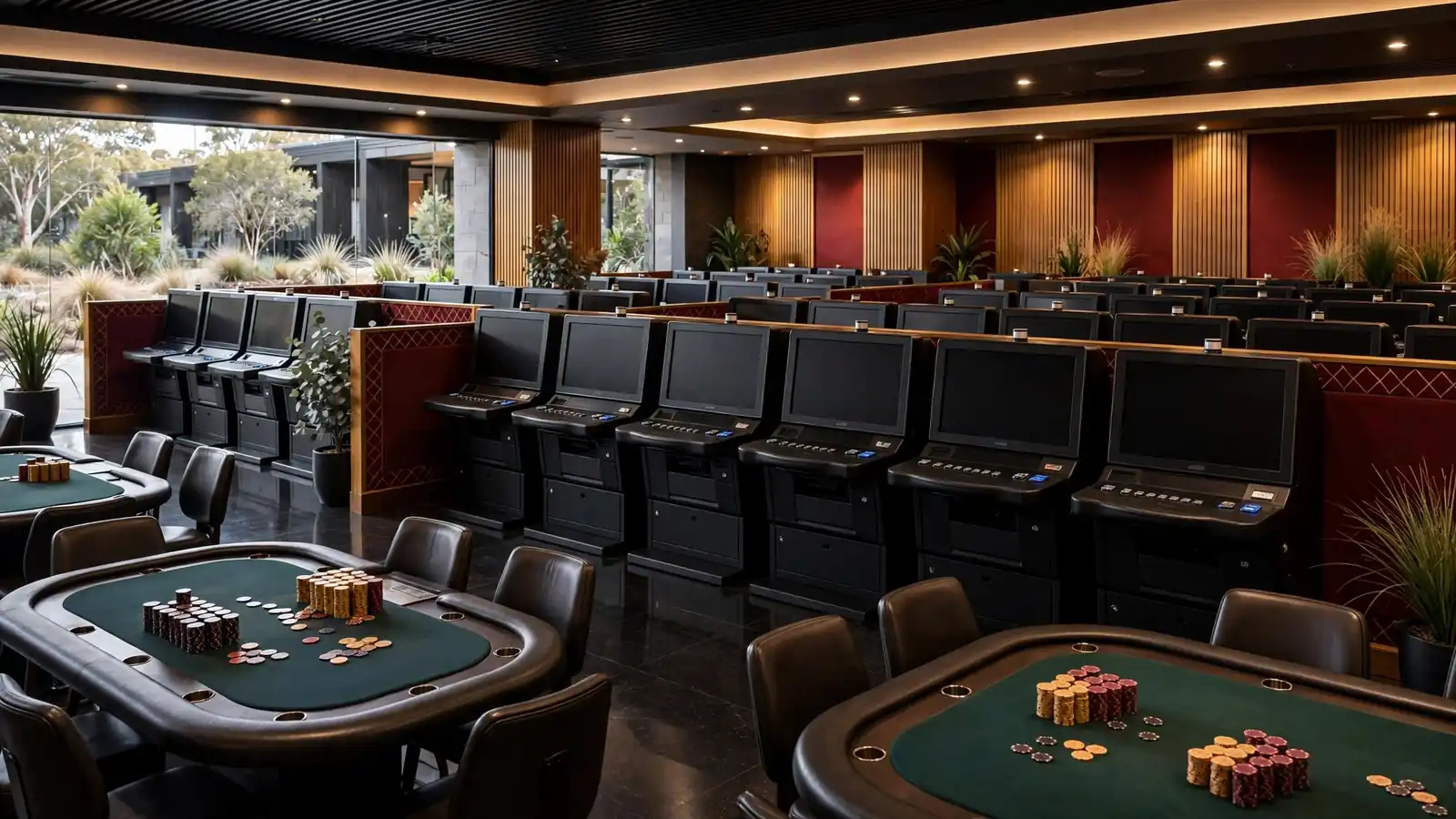
Table of content
The phrase can describe a casino area or a website label; neither wording alone confirms facilities, licensing or an online offer.
A Parlour in a Country of Casinos
“Pokies parlour” sounds like a place with a door, a floor and machines arranged for play. In Australian casino language, though, it is not a precise category of venue. The phrase may describe a section within a physical casino, or it may be a label used by a website. Those meanings can look similar in a search result and lead to very different realities.
In a physical setting, “parlour” suggests a distinct room or area devoted to electronic gaming. It may be a visitor’s informal description rather than the name of an officially recognised part of a casino. “Pokies” is the familiar Australian word for poker machines; “parlour” lends the phrase the air of a self-contained destination. Together they call up a particular scene, but the words alone do not identify a property, establish its facilities or describe its licence.
That distinction matters in a country where casinos are not governed as one national chain of venues. Each casino operates under a licence issued by the state or territory in which it is located, and the industry is regulated at that jurisdictional level. The local licence, not an evocative label, is what places a physical casino within the regulatory structure. The term “parlour” cannot do that work.
Choosing a pokies parlour casino in Australia means weighing the details available for each operator. This list provides a concise reference to the supplied licensing, deposit and payout information.
1. SpinsUp
License: Curacao Gaming Control Board OGL/2023/174/0082 (Dama N.V.) SpinsUp is listed with a Curacao Gaming Control Board licence, OGL/2023/174/0082, held by Dama N.V.
2. LevelUp Casino
License: Curacao eGaming OGL/2023/174/0082 (Dama N.V.) · Min. deposit: A$15 LevelUp Casino lists a Curacao eGaming licence, OGL/2023/174/0082, held by Dama N.V. Its minimum deposit is A$15.
3. MrPacho
Payout speed: crypto 30-120 minutes, fiat 24-72 hours · Min. deposit: A$30 MrPacho lists crypto payouts in 30–120 minutes and fiat payouts in 24–72 hours. The minimum deposit is A$30.
4. Ricky Casino
Payout speed: crypto under 1 hour, PayID 1-3 business days · Min. deposit: A$20 (A$30 to qualify for the bonus) Ricky Casino lists crypto payouts in under an hour and PayID payouts in 1–3 business days. Its minimum deposit is A$20, or A$30 to qualify for the bonus.
5. SkyCrown
License: Tobique Gaming Commission · Payout speed: crypto ~10-15 minutes, fiat 1-5 days · Min. deposit: A$30 SkyCrown lists a Tobique Gaming Commission licence. Its stated payout times are around 10–15 minutes for crypto and 1–5 days for fiat; the minimum deposit is A$30.
6. Kingmaker
Payout speed: crypto ~90 minutes, fiat 1-5 days · Min. deposit: A$30 Kingmaker lists crypto payouts at around 90 minutes and fiat payouts in 1–5 days. The minimum deposit is A$30.
7. Neospin
License: Curacao Gaming Control Board OGL/2023/176/0095 (Hollycorn N.V.) Neospin is listed with a Curacao Gaming Control Board licence, OGL/2023/176/0095, held by Hollycorn N.V.
8. GoldenCrown
License: Curacao Gaming Control Board OGL/2023/176/0095 (Hollycorn N.V.) GoldenCrown is listed with a Curacao Gaming Control Board licence, OGL/2023/176/0095, held by Hollycorn N.V.
9. Thor Casino
License: Curacao – Antillephone N.V. (Versus Odds B.V.) · Min. deposit: EUR 20 Thor Casino lists a Curacao licence held by Antillephone N.V. (Versus Odds B.V.). Its minimum deposit is EUR 20.
10. Wild Tokyo
License: Curacao · Payout speed: crypto 30-60 minutes, fiat 1-5 days · Min. deposit: A$10 Wild Tokyo lists a Curacao licence and a minimum deposit of A$10. Its stated payout times are 30–60 minutes for crypto and 1–5 days for fiat.
The scale of the landscape is sometimes conveyed through figures that need their provenance attached. A specialist review reports more than 20 full-scale casinos across Australia’s eight states, and counts gambling activity in 147 cities. These are that review’s reported figures, not timeless definitions of the industry: venues and classifications can change, while the word “casino” may be counted differently from one inventory to another. The useful point is the breadth of the setting. Casino gambling is part of a national landscape, but its formal rules remain local.
This local structure is easy to miss when a phrase is stripped of place. A “pokie parlour” could be read as a generic room, a marketing description, or simply a cluster of words attached to an online page. None of those readings identifies a particular Australian casino. Nor does the phrase itself show whether a business is a licensed physical property, a directory entry, a promotional name or something operating only on the internet.
Online, the same wording can function as a borrowed image. A site may use “parlour” to suggest the familiarity of a room, while the visitor sees only a domain and a screen. That linguistic resemblance does not turn a website into a bricks-and-mortar venue. More importantly, access to a site or its presentation cannot establish that it is an Australian-licensed online casino. Australian law prohibits operators from providing real-money online casino games to people in Australia. The word on the sign is not the licence behind it.
There is a social history tucked into the phrase. “Parlour” carries older associations of a room set apart for leisure or company, while “pokies” belongs to the everyday vocabulary of Australian gaming. The combination makes machine gambling sound intimate and bounded: not a vast industry, but a room one can enter. Language often shrinks institutions to the size of a familiar space. Regulation does the opposite, revealing the machinery of jurisdictions, licences and public rules behind the room.
The age threshold is national rather than a matter of parlour branding: casino entry is restricted to people aged 18 and over. That baseline sits alongside local licensing, showing two levels at work. The broad rule applies across the country; the operating authority belongs to the relevant state or territory. A room’s name may be casual. Its legal setting is not.
Online Pokies with E-Wallets in Australia
So the phrase can be useful as a description, but not as proof. In a physical casino context, it may point to an area associated with pokies, without establishing that “parlour” is an official venue category. In an online context, it may be a label chosen to evoke that setting, without establishing a lawful Australian casino operation. Between those meanings lies the central ambiguity: a familiar name can describe an impression, while the actual status depends on where and how the activity is provided.
A small phrase, a larger system.
The Sign-Up Bonus That May Not Be Offered
A sign-up bonus sounds like a small welcome at the door: an inducement attached to opening an account, sometimes presented as requiring no initial deposit. In ordinary commercial language, the phrase suggests a benefit waiting for a new customer. In the Australian casino context, however, the promise and the legal position are separate matters. A banner can describe an offer without establishing that an operator may provide it to people in Australia.
That distinction matters because real-money online casino services are not a lawful product for operators to provide to customers located in Australia. The Interactive Gambling Act 2001 prohibits operators from supplying online casino-style games, including slots, poker and table games, to people in the country. A sign-up incentive tied to such a service does not change the nature of the underlying activity. Calling it a welcome reward, a no-deposit offer or a registration benefit cannot turn a prohibited service into a permitted one.
The phrase “no deposit” can make a claim sound unusually frictionless. It implies that an account might receive something before money is put in, and the promise may be framed as a reason to register. But the wording is not evidence that the offer is available to Australians, that it can lawfully be supplied here, or that its conditions have any practical relevance in this market. Promotional copy is a description of what its publisher wants to advertise. It is not a licence.
Highest-Payout Online Casinos in Australia: What RTP Means
The same caution applies to a “pokies parlour” sign-up bonus. The label may combine familiar Australian terminology with the language of online account registration, but the combination does not establish that a physical venue is involved, nor that an online casino operating under that label is authorised in Australia. A name can borrow the atmosphere of local gaming venues while referring to a service delivered over the internet. Familiarity is not jurisdiction.
This is where the boundary between a casino building and an online service becomes important. Australian casinos operate under licences issued by their respective state or territory jurisdictions. Those licences concern the properties and activities governed by local rules; they do not create a general permission for an online casino to offer real-money games nationally. A promotional page that invokes Australian imagery, uses local phrasing or appears tailored to local visitors cannot inherit the legal standing of a land-based venue.
Nor does the apparent simplicity of registration settle the matter. A site may invite account creation and describe a bonus in polished, local-sounding terms. Those details reveal what the page says it offers, not whether that offer may lawfully be made to Australians. The difference is less dramatic than the advertising language would suggest. It is also the difference that matters.
The federal regulator, the Australian Communications and Media Authority, enforces the Interactive Gambling Act 2001 and monitors compliance with federal interactive gambling rules. Where a website provides prohibited services or advertises them to people in Australia, ACMA can ask internet service providers to block access to it. Blocking is an enforcement measure, not a customer review and not a finding that every other address associated with a brand has a different legal status. An address that still loads, or a replacement address that appears later, does not itself establish permission to offer the underlying service.
A sign-up claim can therefore remain visible even when the service it promotes is not lawful to provide here. Online promotions travel easily; regulatory permission does not. The result is a familiar mismatch between the confident grammar of advertising and the less theatrical work of law. “Claim,” “join” and “welcome” are persuasive verbs. None is a legal category.
Legal Prohibition
Under the Interactive Gambling Act 2001, it is prohibited for operators to provide real-money online casino games, including slots, poker, and table games, to people in Australia.
For Australian readers, the meaningful question is not whether a page calls an incentive a no-deposit bonus. It is whether the underlying online casino service may be offered to people in Australia. Under the national framework, operators cannot provide real-money online casino games to customers here, and advertising such services to Australian audiences is prohibited. A sign-up offer cannot sit outside that rule merely because it is described as free to receive.
That is the limit of the promise. A phrase can announce an incentive; it cannot make the incentive lawful, locally available or reliable. The welcome may be only words.
Online Play, Free Play and the Australian Boundary
Online access can make a casino-style site look like an ordinary entertainment service: a page loads, an account area appears, and the language promises play from home. None of those signs settles the question that matters in Australia. A website may be reachable, receive account traffic or move to another web address without being an Australian-licensed online casino.
Real-Money Pokies Apps in Australia: Legal Limits
That distinction is not a technicality. The Interactive Gambling Act 2001 prohibits operators from providing real-money online casino games to people in Australia. The rule covers casino-style services such as slots, poker and table games. A site’s own description, or the ease with which it opens on a screen, cannot turn a prohibited service into a locally authorised one.
The law is directed at operators, not at making a player’s access itself a criminal offence. That difference can disappear in promotional copy, where a familiar-looking sign-in page is presented as though availability were a kind of approval. It is not. A web address is a route to a page, not a licence.
What “free play” can mean
The phrase “play free” is especially loose. It might refer to a demonstration interface, a promotional claim, or simply language designed to invite a visitor further into a site. Without reliable evidence about the service behind it, the words do not establish what is being offered, who operates it, or whether it is lawful for the Australian market.
Nor does a free-play label change the legal boundary around real-money online casino services. A page can place a free option beside account functions or other material, but the appearance of that option does not validate the wider service. The key issue is not the label on a button; it is the nature of the service and the rules that apply to its provision in Australia.
This is why “online” and “free” should not be read as reassuring descriptions by themselves. They are interface language, not regulatory categories. The distinction is quieter than the marketing. It is also more important.
Why a site may disappear or move
Australian access can change when a domain is blocked. The Australian Communications and Media Authority enforces federal interactive gambling laws and may ask internet service providers to restrict access to websites offering prohibited services or advertising them. A specialist industry review describes how such blocking can affect which web addresses resolve for Australian users, while alternate addresses may emerge over time.
That changing pattern can create a misleading impression. A former address may stop loading; another may appear to work. Neither event proves that a service has become lawful, acquired an Australian licence or been cleared by a regulator. Domain changes describe the shifting mechanics of access, not a change in legal status.
ACMA Enforcement
The Australian Communications and Media Authority enforces federal interactive gambling laws and may request internet service providers to block access to websites offering prohibited services.
The scale of enforcement is substantial. Since November 2019, ACMA action has led to blocks affecting more than 1,455 gambling and affiliate websites. The agency has also reported that over 190 illegal services withdrew from Australia after enforcement began in 2017; another published count puts the total above 210. Those figures differ, so neither should be treated as a settled single tally. The direction of the record is plain enough: blocking and withdrawal are part of how the federal boundary is enforced.
A search for online play, or for a free version, therefore leads to two separate questions: what does the page appear to offer, and what is its status under Australian law? Accessibility can answer only the first imperfectly. It cannot answer the second. The screen may be present. The permission is another matter.
Free Spins and Chips: Promotional Words, Not Proof
“Free spins” and “free chips” sound like small gifts, the digital equivalent of a token pushed across a counter. But promotional language is not a receipt, and a phrase on a page cannot establish that an offer exists, who may receive it, or what using it would involve. The word free does a great deal of work while explaining very little.
The distinction matters in Australia, where real-money online casino games are prohibited for operators to provide to people in the country under the Interactive Gambling Act 2001. A page that describes spins or chips as complimentary does not, by that wording, turn an online casino service into a lawful one. Nor does a familiar casino term prove that the advertised feature is a genuine product rather than a line of marketing.
Casino Apps for iPhone in Australia: Legal Guide
The language also blurs different things. “Free” might be used to describe a promotional claim, a demonstration mode, or a feature presented without an immediate payment. Those descriptions are not interchangeable, and none settles what happens beyond the label. A claim can omit restrictions, eligibility, or other conditions; without evidence of the specific offer and its terms, the attractive adjective is all that can safely be established.
That uncertainty is not a technicality. Promotions borrow the old social grammar of hospitality: a complimentary drink, a house gift, a welcome. In a gambling context, the gift may be designed to draw attention to the activity surrounding it. The warmth of the word does not change the nature of the service. A velvet ribbon remains a ribbon.
A search result or a page headline may repeat “free spins” or “free chips” without showing whether the offer is current, available in Australia, or supported by clear terms. Repetition is not confirmation. A polished design, a lively countdown, or a prominent button would still be presentation, not proof of lawful availability. The claim has to be separated from the machinery of persuasion around it.
There is another complication: domains and pages can shift. A regulatory account records ACMA blocking action against illegal gambling services, including alternate domains associated with Fair Go. That is evidence of enforcement activity, not evidence that a new address—or a page carrying a free-play claim—has acquired Australian authorisation. The address can change. The legal character does not follow it like a suitcase.
Attention: A professional design or the availability of a website does not prove that an operator is lawfully authorised to provide casino services in Australia.
So the useful reading of these phrases is narrow. They indicate that a site is making a promotional claim about spins or chips. They do not verify a product, guarantee a benefit, or establish that Australians can lawfully take up the offer. The adjective is doing the selling. It is not doing the proving.
In gambling, a free label can feel like a harmless invitation because it seems to remove the price from the decision. Yet it may only move attention away from the question that matters: what service is being offered, and on what legal footing? The language may be bright. The evidence must be brighter.
How to Read a Pokies Parlour Review
A review can describe a website convincingly without establishing what the site is allowed to offer in Australia. Screenshots, polished wording and a familiar-looking name are evidence of presentation, not of an Australian licence. The distinction matters because a physical casino and a website carrying casino-style games belong to different regulatory settings.
A useful review separates what it can observe from what it merely repeats. It may report that a page loads, that an account form is available or that the operator has changed its web address. Those details describe a site’s visible behaviour. None proves that the operator holds an Australian licence to provide online casino games. Accessibility is not authorisation.
The same caution applies to an alternate domain. A new address might appear after an earlier one stops resolving, but a change of address does not change the legal status of the service behind it. Nor does a review establish legitimacy by showing that the replacement page looks professional or accepts account traffic. A website can be operational and still lack Australian approval for the activity it presents.
Best Casino Apps in Australia: Access and Safety
That is the point at which a review’s language deserves close attention. Words such as “trusted”, “official” or “licensed” are conclusions, not supporting evidence. A careful account should make clear what each description rests on and avoid presenting design details as regulatory proof. If it treats an accessible page as confirmation of Australian licensing, it has crossed from observation into inference.
There is also a category problem hidden in the phrase “pokies parlour”. It can evoke a physical gaming venue, while a website may borrow the same language to suggest an online destination. A review that moves between these meanings without explaining the difference can leave the impression that recognition of the phrase carries over into recognition of the operator. It does not.
The Australian framework makes that distinction consequential. The Interactive Gambling Act 2001 prohibits operators from providing real-money online casino games to people in Australia. A review of a website cannot convert that prohibited service into an Australian-licensed casino by calling it a parlour, describing its interface or noting that its domain remains reachable. On this point, appearance is a poor witness.
A sound review therefore keeps its claims narrow. It can report what is visible on a page and what happens to its address, while distinguishing those observations from proof of lawful Australian operation. It should not imply that an alternate domain, an account pathway or a convincing brand settles the licensing question. Where those limits are blurred, the review may tell more about its own confidence than about the site it describes.
For a casino review, the central test is not whether the website looks like a venue. It is whether the claims about its status are supported by something more substantial than the website’s own presentation. A domain can change. The underlying distinction remains.
Where Australian Casinos Sit on the Map
Australia’s casino geography is not a neat chain of city centres. Large urban properties sit alongside venues in regional places, and the distance between them can change what a casino means to its surrounding community: a landmark in a tourist district, a local employer, or one of few major entertainment sites in a wide area. The map is shaped by state and territory licensing, but the places themselves belong to quite different landscapes.
A specialist gambling-industry review identifies Sydney, in New South Wales, as the country’s largest gambling city, listing 11 gambling facilities there. That figure describes a particular review’s count, not a permanent civic category: facilities and classifications can change, and “gambling city” may cover more than casinos. Still, Sydney’s position in the account points to the concentration of venues in a major metropolitan centre, where casino buildings are only one part of a much larger urban leisure economy.
The Northern Territory offers a contrasting scale. A specialist review counts three casinos across three cities in the territory, and identifies Alice Springs as the city with the greatest number there: one. The wording is almost comically modest; in this count, “greatest” means a single property. Yet regional geography makes that single address more legible than a number alone. Lasseters Casino is at 93 Barrett Drive, Alice Springs, NT 0870, Australia, placing it within a town whose name carries a particular weight in the country’s interior.
A street address is more than a pin. It anchors a venue in a place with its own distances, histories and everyday routines, rather than in the abstract category of “Australian casino”. Alice Springs is not a suburb of a coastal capital, and its casino cannot be read simply as another stop in a metropolitan entertainment precinct. The same national label therefore covers markedly different settings, from dense urban networks to regional centres.
Pokies Open Near Me in Australia: Casino Hours
That difference matters when casino lists flatten the country into a row of names. A city count can suggest concentration; an address restores the ground beneath it. Neither tells the whole story by itself. Counts depend on what a directory classifies as a gambling facility, while a venue address says where a property is, not how central it is to local life. Geography supplies context, not a verdict.
The Northern Territory’s reported distribution also warns against assuming that population size alone explains where casinos appear. The review’s count places one casino in each of three cities, with Alice Springs leading the territory’s city-level tally. Those details should be read as a snapshot from a specialist review, rather than as a timeless census. The map is an account made at a particular moment, and its categories belong to the account as much as to the landscape.
Seen this way, “pokies parlour” is less a destination than a loose label laid over very different places. In one setting, the casino is part of a large city’s crowded entertainment fabric; in another, a named property sits at a precise address in the interior. Australian geography resists the idea that one phrase can describe every venue’s surroundings. The map is not uniform.
Sydney, NSW
Identified as the country’s largest gambling city with 11 gambling facilities.
Alice Springs, NT
Home to Lasseters Casino at 93 Barrett Drive, representing the highest count in its specific city tally.
Northern Territory
A regional landscape featuring three casinos across three different cities.
Bonus Claims and the Rules Around Them
A bonus is not merely a generous-sounding noun. In gambling, it can be an inducement: language designed to make participation more attractive. That distinction matters in Australia, where the Interactive Gambling Act 2001 prohibits operators from providing real-money online casino games to people physically in the country. A promotional claim does not change the legal character of the service it promotes.
The prohibition covers casino-style online games such as slots, poker and table games. Advertising prohibited online gambling services to Australians is also banned. So a claim about a “pokies parlour bonus” cannot establish that an offer is lawful, available locally or attached to an Australian-licensed online casino. The wording is a claim, not a licence.
The enforcement record gives that boundary practical weight. The Australian Communications and Media Authority (ACMA), the federal body responsible for enforcing the Act, can investigate operators and take action when prohibited services are provided or advertised. It can also ask internet service providers to block websites carrying prohibited gambling services or their advertising. ACMA reports that, following enforcement action, more than 1,455 illegal gambling and affiliate websites have been blocked since November 2019.
There is a discrepancy in reported withdrawal totals. One account says more than 210 illegal services have left the Australian market since ACMA began enforcing the rules in 2017; another gives the figure as over 190. Both accounts describe withdrawals in response to enforcement, not proof that every prohibited service has disappeared.
The penalties underline the seriousness of the operator-facing rules: the maximum daily penalty is $360,000 for an individual and $1.8 million for a corporation. These are not promotional terms, and they do not turn a bonus claim into evidence of a permitted offer. The regulator’s concern is the service and its advertising, not the persuasive ingenuity of a banner.
A search for a parlour bonus may therefore lead to language that sounds commercial and familiar while sitting outside Australia’s lawful online casino market. In this setting, promotional wording is a poor guide to legality. The rules are less decorative.
What “VIP Parlour” Can—and Cannot—Establish
“VIP parlour” sounds like a category with a door, a membership rule and a particular kind of welcome. The phrase alone establishes none of those things. It may be used as a venue description, a promotional label or simply a string of words attached to a casino name. Without confirmed information about a specific property, it cannot show that a separate room exists, who may enter it or what privileges might apply.
That distinction matters in Australia, where a casino is not licensed by a single national authority. Each property operates under a licence issued by the state or territory in which it is located. A label used in advertising or on a website does not replace that local licence, nor does it demonstrate that a venue has a distinct VIP area.
The established entry threshold is clearer: casino entry is restricted to people aged 18 or older nationwide. Major casinos also require valid photo identification for entry. Those are general conditions, not evidence of a special status attached to a “VIP parlour”. Any additional access arrangement would need to be confirmed by the relevant venue rather than inferred from the wording.
Do
- Verify the licence issued by the specific state or territory
- Ensure the visitor is aged 18 or older
- Provide valid photo identification for entry
Don’t
- Rely on labels like “VIP parlour” as proof of access
- Assume national licensing exists for casinos
- Infer membership rules from promotional wording
There is a small social history in the label. “VIP” borrows the language of rank; “parlour” suggests a room set apart from the ordinary flow of a public building. Together, they invite an image of selective hospitality. An image is not an access policy.
A careful account therefore keeps the claim modest. The phrase may indicate how a venue or a third party chooses to describe an experience, but it cannot by itself establish a room, membership, entry criteria or licensing status. Those questions belong to the named property and its jurisdiction.
The label is not the licence.
Parlour Pokies and the Casino Machine Landscape
The phrase “parlour pokies” can suggest a room defined by its machines. In Australia’s casino context, however, the more useful measure is not the name attached to a room but the licensed equipment recorded across casino venues. The national total is 3,308 gaming machines endorsed on venue licences and installed in casinos.
That figure describes the scale of the casino machine landscape, not a particular parlour, property or style of play. It does not show how the machines are arranged, how many sit in any one venue, or what a venue calls its gaming areas. A label can sound precise while leaving those practical details untouched.
There is a distinction between the number authorised on venue licences and the number physically installed. Here, the recorded total refers to machines that are both endorsed on licences and installed in Australian casinos. It is therefore a count of casino equipment, not a national tally of every gaming machine in every kind of venue. The boundary matters: a parlour-like name does not turn a casino count into a count of all gambling premises.
Casino licensing is handled by each state and territory, with each property operating under a licence from its local jurisdiction. That arrangement gives the national total a federal outline but a local administrative structure. The machines are counted within licensed casino venues; they do not form one centrally managed national room.
Nor does the total establish that every casino has the same range or number of machines. It supplies a scale, not a catalogue. The plain figure is substantial enough to describe an industry feature, but it cannot verify claims about a specific parlour or what someone might find inside one.
A count, not a floor plan.
Real-Money Searches and the Limits of a Domain
A website can look operational without being authorised to provide real-money casino games in Australia. A working address, account page or payment prompt establishes only that parts of a site are reachable; none proves that it is an Australian-licensed online casino. The distinction matters because the Interactive Gambling Act 2001 prohibits operators from providing online casino games for money to people in Australia.
Domains are not durable credentials. Australian internet providers may be required to block access to websites offering prohibited gambling services or advertising them. When an address stops resolving, another may appear, but a changed ending or a polished replacement page does not alter the legal position. A new door is still attached to the same question.
The Australian Communications and Media Authority enforces federal interactive gambling rules and can seek blocking action against sites. Its enforcement record includes action involving alternate domains associated with Fair Go, as reported in a specialist review. That is evidence of domain-level enforcement, not proof that a particular address is safe, lawful or licensed. Nor does a site’s temporary availability settle the matter: access can vary with blocking and internet-provider settings.
The relevant test is not whether a real-money section can be opened, or whether a business presents itself as a casino. Online casino-style games remain prohibited when supplied to customers in Australia, including when the operator is offshore. A domain name is an address, not a regulatory document.
Casino apps for Android in Australia: access guide
This can make the search for a real-money parlour feel like a search for a place. Yet the familiar language of a venue does not turn an online service into a physical casino, and a functioning website does not confer local authority. On this market, appearance and permission are separate things. A plain distinction.